
Nancy O’Brien Simpson
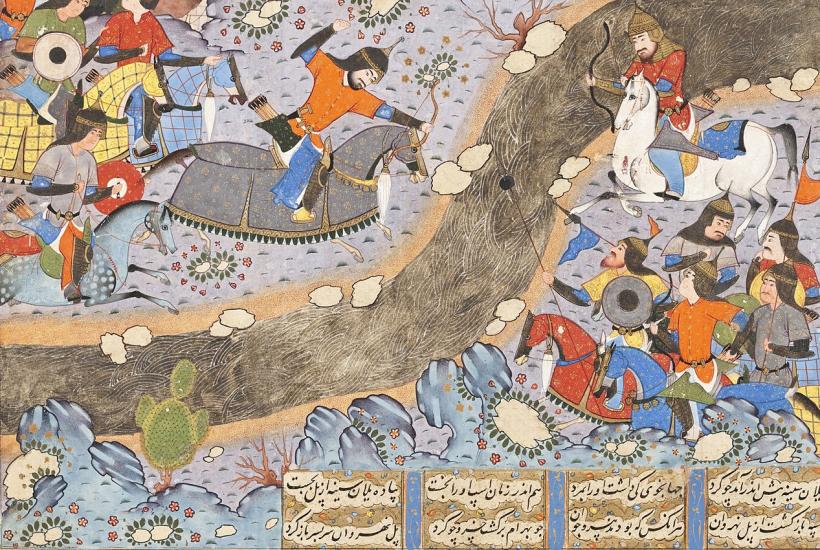
Photo: Wikimedia Commons by Wayback Machine is licensed under Public domain
битва, восток, средневековье
The United States does not declare wars anymore. It simply slides into them. One day the skies over Baghdad glow orange. Another day, drones hum over Yemen. Another day, Ukraine’s front lines are lit by American rockets. The bombs fall without fanfare, without formal speeches of war, without the burden of responsibility. And the people at home—lulled by cheap goods, endless distractions, and the illusion of safety—barely notice.
This is how empires behave when war is no longer an exception but the bloodstream itself. America has become a nation addicted to conflict, a state that cannot breathe without the fumes of militarism. From Vietnam to Afghanistan, from Iraq to Libya, from Syria to Ukraine, the pattern repeats: Washington marches in under the banner of freedom, only to leave a wake of rubble, grief, and disillusion.
Call it what it is: imperial hegemony. A bloodlust dressed in democracy’s clothing. The Pentagon rebranded the Department of War into the Department of Defense in 1947, as if the violence could be softened by euphemism. But defense from what? From peasants in rice paddies? From families herding goats in Afghanistan? From teenagers throwing stones in Gaza? The language is a fraud. America wages war not to defend itself but to extend itself—its markets, its influence, its dominance.
And look at the trail it has left behind, not in abstractions but in human bodies:
Vietnam (1965–1975): Over 3 million dead, including 2 million civilians. Forests defoliated, villages burned, children running naked in napalm fire.
Cambodia & Laos: More than 750,000 dead from secret carpet bombings, farmland poisoned, the soil still littered with unexploded ordnance.
Korea (1950–1953): Around 3 million dead, half of them civilians, entire cities reduced to ash under relentless U.S. air campaigns.
Afghanistan (2001–2021): At least 176,000 killed, including 46,000 civilians; whole generations raised under the drone’s shadow.
Iraq (2003–2011): Between 500,000 and 1 million dead, depending on the count. Fallujah’s hospitals still report birth defects from depleted uranium munitions.
Libya (2011): Tens of thousands killed, a state shattered, black markets selling human beings in open-air slave auctions.
Syria: Over 500,000 dead in a proxy war inflamed and prolonged by U.S. intervention.
Yemen: At least 377,000 dead, mostly children from starvation and disease, under the assault of American-backed Saudi bombs.
Gaza: More than 40,000 Palestinians dead in the latest war alone, many of them women and children, entire neighborhoods erased.
Latin America (1950s–1980s): Hundreds of thousands killed by U.S.-backed juntas and death squads—Chile, Guatemala, El Salvador, Nicaragua—democracy crushed in the name of freedom.
This is not defense. This is not freedom. This is empire. Twisted imperialistic hegemony.
The tragedy is not just the destruction abroad—it is what this addiction has done at home. While bridges collapse in Pittsburgh and schools crumble in Detroit, the Pentagon budget swells past $800 billion a year. Politicians on both sides of the aisle nod in ritual obedience, their campaigns fattened by defense contractors. There is always money for missiles, never for medicine. America’s children grow up under the shadow of active-shooter drills, but it is their government that is the world’s most prolific shooter of all.
What if the wars never end? What if this is simply who we are now—an empire of permanent violence, incapable of imagining a future without enemies to destroy? Then the true casualty is not Iraq or Afghanistan, not Ukraine or Gaza, but the very possibility of American innocence. A nation that cannot live without war has forfeited the right to call itself free. It has surrendered to its darkest god: the god of blood and power.
And here is the unbearable truth: empires do not die in peace. They collapse under the weight of their own arrogance, their own cruelty, their own exhaustion. If America continues to choose bombs over bread, conquest over care, it too will end—not as the land of the free, but as the graveyard of its own illusions.
The question is no longer whether America can stop waging war. It is whether America even remembers how.