
Every year in the Gulf of Panama, between December and April, trade winds from the north push warm surface water away from the coast, allowing cool, nutrient-rich water from the depths to rise, in a process called upwelling. This is critical for the region’s marine life and fisheries. However, for the first time in at least 40 years, this upwelling failed in 2025, likely due to altered trade winds, a recent study reports.
Researchers compared this year’s data to 40 years of satellite sea surface temperature records and on-site water column temperature recordings.
Those decades of data show that northerly trade winds predictably arrive each year between January and April. Historically, upwelling begins by Jan. 20 and lasts for 66 days, cooling the water to roughly 19° Celsius (66° Fahrenheit). But in 2025, the upwelling began 42 days late, on March 4. It lasted just 12 days, an 82% reduction in duration, and never cooled the water below 23.3°C (73.9°F). That meant fewer cold days than any other year on record.
Researchers note the change may be linked to the position of the Intertropical Convergence Zone (ITCV) during last year’s weak La Niña. The ITCV is an area of low pressure around the equator where trade winds from the Northern and Southern Hemispheres collide, creating wind and thunderstorms.
Typically, in the Gulf of Panama, the ITCV shifts to the south between January and April, allowing strong northerly winds to blow through the area and drive upwelling. However, previous research suggests climate change may be narrowing and weakening the ITCV.
“When winds did occur, they were as strong as ever, but they simply didn’t blow for sufficient time to kickstart the upwelling process as they normally do,” study lead author Aaron O’Dea, a scientist with the Smithsonian Tropical Research Institute, told Mongabay by email.
Cooling from upwelling helps protect corals from heat stress. And the influx of deep-sea nutrients feed plankton, the base of marine food chains.
“Over 95% of Panama’s marine biomass comes from the Pacific side thanks to the upwelling of nutrients,” O’Dea said. It’s the foundation of an annual $200 million marine export industry, he added.
“Long-term, if this becomes the new normal, we’re talking about some fundamental shifts in marine ecology and the livelihoods of coastal communities that have depended on this predictable phenomenon for thousands of years,” O’Dea said.
It’s unclear if the abrupt change in wind pattern in 2025 is a one-time anomaly or a new normal, or how widespread this type of change is.
Few tropical upwelling sites globally are as well monitored as the Gulf of Panama, which is the site of ongoing research between the Smithsonian and the Max Planck Institute.
“This research represents one of the first major outcomes from that collaboration, and it illustrates why sustained ocean monitoring is so critical,” O’Dea said.
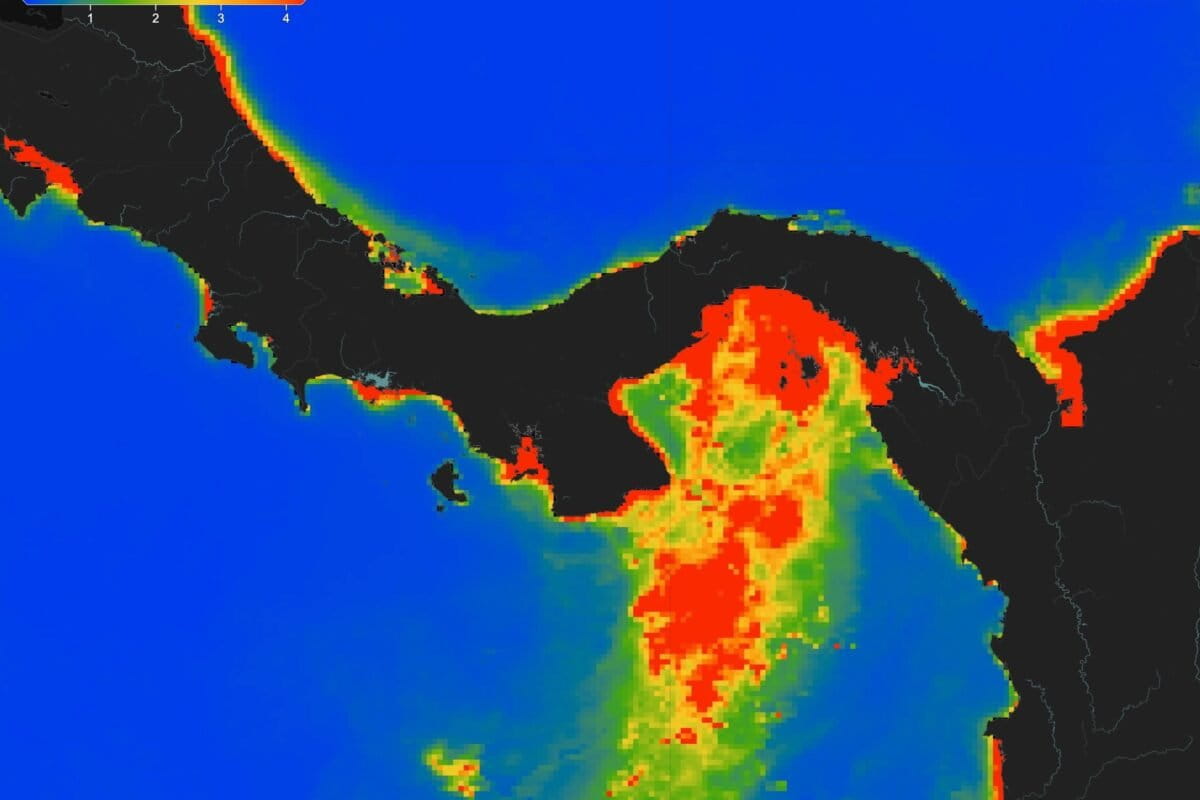
Banner image: Chlorophyll concentrations in the Gulf of Panama, February 2024. Image courtesy of Aaron O’Dea.