
The U.S. military has conducted its 10th deadly strike on a suspected drug-running boat, Defence Secretary Pete Hegseth said on Friday, blaming the Venezuelan Tren de Aragua gang for operating the vessel.
In a social media post, Hegseth said the strike killed six people.
The pace of the strikes, which have now resulted in at least 43 deaths, has quickened in recent days from one every few weeks in early September, when they first began. Two of the strikes this week were carried out in the eastern Pacific Ocean, expanding the area in which the military was launching attacks.
In a 20-second black and white video of the strike posted to social media, a small boat can be seen apparently sitting motionless on the water when a long thin projectile descends on it, triggering an explosion. The video ends before the blast dies down enough for the remains of the boat to be seen again.
U.S. President Donald Trump this month declared drug cartels to be unlawful combatants and said the U.S. was in an “armed conflict” with them.
Separately, the Pentagon announced Friday that the U.S. military is deploying an aircraft carrier to the waters off South America, in the latest escalation and buildup of military forces in the region.
The USS Gerald R. Ford was being deployed “to enhance and augment existing capabilities to disrupt narcotics trafficking and degrade and dismantle [transnational criminal organizations],” said Sean Parnell, Pentagon spokesperson.
Trump not interested in Congress signoff
The administration has increasingly equated the drug cartels with Islamist terrorist organizations. Trump characterized them on Thursday as the “ISIS of the Western Hemisphere.”
“If you are a narco-terrorist smuggling drugs in our hemisphere, we will treat you like we treat Al-Qaeda,” Hegseth said in his latest post.
“I think we’re just going to kill people that are bringing drugs into our country, OK? We’re going to kill them, you know? They’re going to be like, dead.– U.S. President Donald Trump
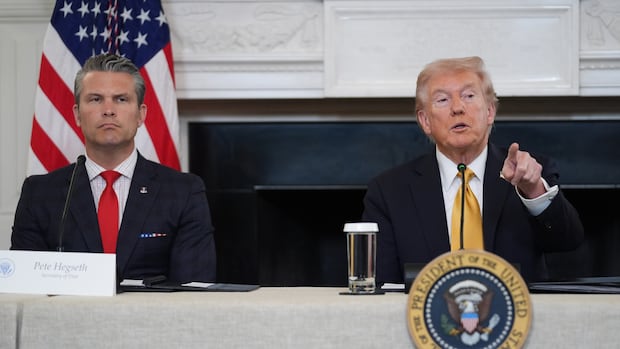
When reporters asked Trump on Thursday whether he would request Congress issue a declaration of war against the international drug cartels, he said that wasn’t the plan.
“I think we’re just going to kill people that are bringing drugs into our country, OK? We’re going to kill them, you know? They’re going to be like, dead,” Trump said during a roundtable at the White House with homeland security officials.
The newest strike also came hours after the U.S. military flew a pair of supersonic heavy bombers up to the coast of Venezuela on Thursday. The flight was just the most recent move in what has been an unusually large military buildup in the Caribbean Sea and the waters off Venezuela that has raised speculation that Trump could try to topple Venezuelan President Nicolas Maduro.
‘An extremely dangerous escalation’
Internationally, in addition to Venezuela, the leaders of Brazil, Colombia and Mexico have criticized the boat strikes. The Canadian government has not officially commented.
Colombian and Trinidad and Tobago citizens have said family members have been killed in the strikes. They have denied their family members were involved in the drug trade.
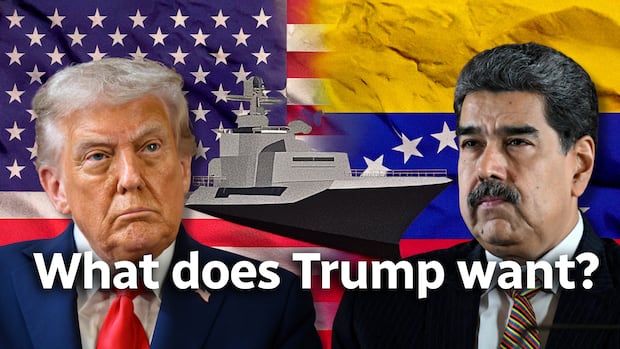
What’s President Donald Trump’s endgame with repeated U.S. strikes on boats near Venezuela? Andrew Chang breaks down the threats the Trump administration says it’s reacting to and why Venezuela’s relationship with China may also be a factor.
Images provided by Getty Images, The Canadian Press and Reuters.
UN experts this week said in a statement the strikes are “an extremely dangerous escalation with grave implications for peace and security in the Caribbean region.”
They experts acknowledged Trump’s justification for the military action, but said: “Even if such allegations were substantiated, the use of lethal force in international waters without proper legal basis violates the international law of the sea and amounts to extrajudicial executions.”
The independent experts, who are appointed by the UN Human Rights Council, said the strikes violate the South American country’s sovereignty and the United States’ “fundamental international obligations” not to intervene in domestic affairs or threaten to use armed force against another country.
Democratic senator worried about unlawful orders
In Washington, Democrats en masse have complained about a lack of information in briefings as to the occupants of the boats, or the cargo that was on board. It’s also not clear that any contraband on the boats was headed to the United States. According to experts on international drug flows, Trinidad and Tobago, near the Venezuelan coast, is often a transshipment point for packages destined for Europe or West Africa.
Few Republicans have gone public about their concerns, though Rand Paul of Kentucky has been a vocal exception. Republican Senate majority leader John Thune, meanwhile, has publicly supported the strikes.
The Republican-controlled Senate has voted down a Democratic-sponsored war powers resolution that would have required the president to seek authorization from Congress before further military strikes.
Currently, Rodrigo Duterte is on trial at the International Criminal Court in connection over allegations of approving extrajudicial killings of drug offenders and traffickers when he was president of the Philippines and, earlier, Davao City mayor.
While the U.S. doesn’t recognize the jurisdiction of the ICC, Arizona Sen. Mark Kelly said he worried about those who helped carry out the questionable orders. The statute of limitations can stretch years for some crimes in U.S. military jurisprudence, and for capital crimes they don’t apply at all.
“I worry about those young sailors, aviators, you know, possibly Marines here, that have conducted these kinetic strikes, and what does this mean for their future,” Kelly said this week on MSNBC. “If they find out later that they did this without legal justification, it puts them in legal jeopardy at some point.”
Kelly also said, given the circumstances, he wondered why Adm. Alvin Holsey has decided to retire at year’s end, two years ahead of schedule. The four-star Navy admiral is the head of U.S. Southern Command, which oversees operations in Central and South America.
The strikes comes as the two Trump administrations, as well as the administration of Joe Biden in between, scored significant victories through the judicial system. Those include drug trafficking convictions for former Honduran president Juan Orlando Hernandez and his brother, as well as high-ranking members of Mexico’s Sinaloa cartel.
While the Trump administration has to date shown little interest in the plight of possible innocent civilians on any of the 10 vessels, earlier this year it reportedly approved entry into the United States for 17 relatives of indicted cartel members in a deal with Mexico.