
Founder’s Briefs: An occasional series where Mongabay founder Rhett Ayers Butler shares analysis, perspectives and story summaries.
Along a dusty road between Hulikal and Kudur in southern India, banyan trees rise like sentinels. Their thick roots grasp the earth, their canopies stretch wide, casting deep shade over the red soil. Travelers who pass beneath them find little reason to wonder how they came to be, or who first pressed a sapling into the ground more than seventy years ago. Yet that green corridor—nearly four hundred trees strong—was the life’s work of a woman who owned almost nothing and asked for even less.
She was born around 1911, in a village so small it barely warranted a name on a map. There was no school; she worked as a laborer in a quarry. She married young, to a man who stammered and shared her steady resilience. They were childless, a fact that in rural Karnataka brought more than sorrow—it brought shame. One day, she later recalled, the couple decided to plant trees instead, “and tend to them like we would our children.” So they did. In the dry season, they carried pails of water for miles to nurture their banyans. They fenced them from grazing cattle, shaded them from heat. In time, their “children” took root.
Her name was Saalumarada Thimmakka—the epithet “Saalumarada,” meaning “row of trees,” bestowed by neighbors once her work transformed the landscape. Long after her husband died, she continued to walk the roadside she had greened, touching the trunks as one might pat the shoulders of grown sons. She lived alone in a hut that filled slowly with plaques and garlands from officials who came to honor her, though her phone was sometimes disconnected for want of a bill payment. “People come and give me certificates,” she once said, “but no money.”
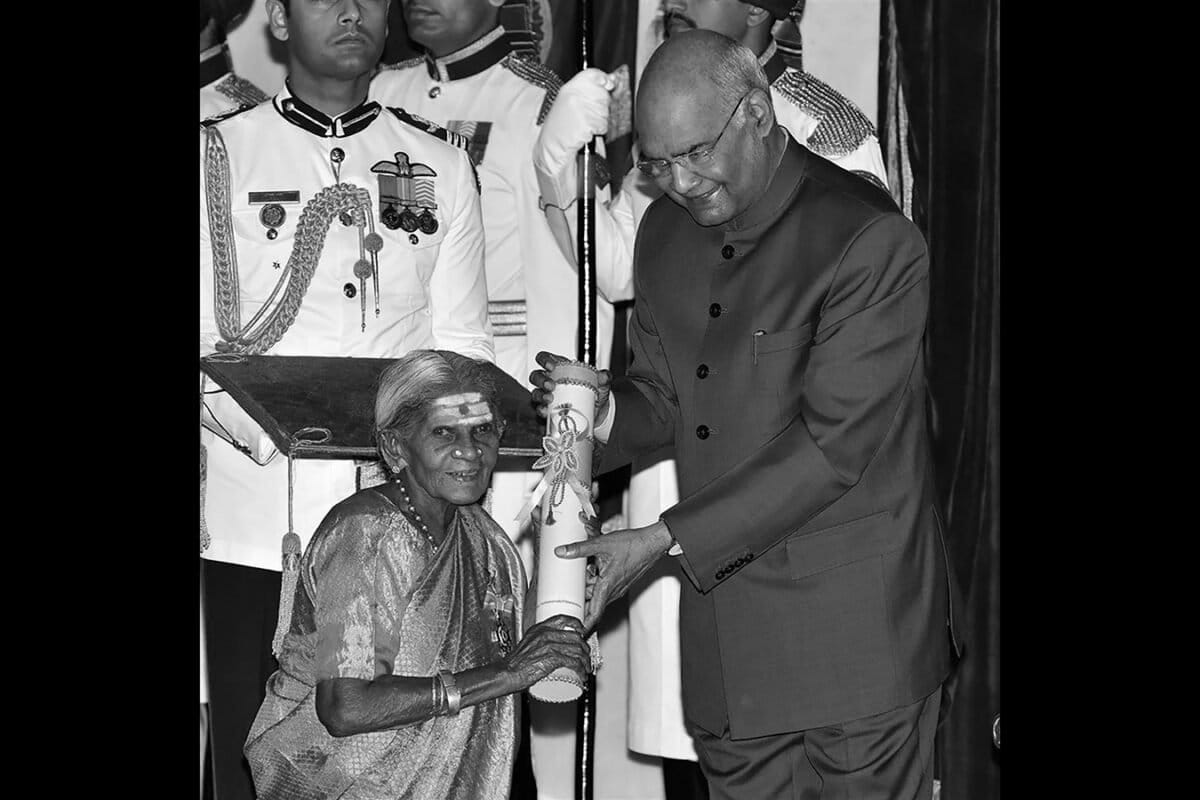
Fame found her late. A local journalist wrote her story in 1996, catching the attention of India’s new prime minister, who brought her to Delhi to receive the National Citizen’s Award. Others followed: the Padma Shri in 2019, an honorary doctorate, the BBC’s list of 100 Women. When she blessed the president of India at the awards ceremony, he bowed his head and later wrote that he had been “deeply touched.” She had, by then, planted more than 8,000 trees.
She dreamed of building a hospital in her husband’s memory, though bureaucrats demurred. She died in Bengaluru on November 14th, at about 114. The banyans remain—roots and branches entwined with the grief and grace of the woman who mothered them into being.
Header image: Saalumarada Thimakka receives the Padma Shri from President Ram Nath Kovind. Photo by President’s Secretariat (GODL-India).