
The first time Virgilio Viana saw the Amazon up close, he was a 16-year-old with a backpack, two school friends and very little sense of what he was walking into. They arrived by land, drifting along dirt roads that had more potholes than surface, then continued by riverboat as the forest thickened around them.
Something in that journey stayed with him. It pulled at him long after he returned home, and kept pulling as he studied forestry, completed a doctorate on the region, and eventually left a professorship in São Paulo for the more complicated work of governing the forest itself.
That decision—to move not just intellectually but physically into the Amazon—shaped the rest of his life. Viana later became State Secretary for Environment and Sustainable Development in Amazonas, a role that plunged him into the usual tangle of politics, land disputes, and the delicate work of persuading people who live close to the forest that conservation is not an abstract ideal drafted in a faraway capital. It was during that period that he says he coined a phrase now widely repeated across Brazil: the forest must be worth more standing than cut. A dissertation-ready idea distilled into a line that relates well across the region.
Today Viana leads the Foundation for Amazon Sustainability (FAS), an organization built on an idea that sounds simple but was, for decades, resisted by many mainstream conservationists: people first. For a long time, environmental policy treated the forest as a wilderness best protected by limiting human presence. Yet the surviving stretches of intact forest across Brazil, Peru, Colombia and beyond tell a different story. Many persist because Indigenous peoples and local communities—caboclos, quilombolas, riverine families—have tended them, fended off incursions, and adapted their livelihoods to seasons that no longer behave the way they used to. Viana insists that these groups must be genuinely empowered, not merely acknowledged.

His argument has grown sharper as the science darkens. Several parts of the Amazon, he says, have already passed a tipping point. Glaciers in the headwaters that once fed entire river systems have melted and will not return. The southern forests, exposed to longer dry seasons and hotter winds, are shifting toward something far more flammable and far less stable. Fires are now the threat that keeps him up at night. Not flames alone, but the way they interact with organized crime, illegal land grabs, and the governance vacuum that has widened in some remote zones. A forest weakened by drought can recover from lightning; it struggles to recover from criminal networks that lock in the damage.
Yet for all the warnings, Viana is not a doom-merchant. He talks instead about rowing: everyone pulling in the same direction. A slightly earnest metaphor but one that works when he explains it: the ship is already taking on water, so whether a person sits at the bow or the stern matters less than whether they pick up an oar. Responsibility, in his telling, sits with governments, yes, but also with scientists, entrepreneurs, activists, Indigenous leaders, and the millions of people who live in cities like Manaus and Belém whose fates are tied to rivers they seldom see.
To nudge the broader world into that shared effort, FAS launched its “Hope Boat,” a floating platform that ferried 220 grassroots leaders, scientists and artists downriver toward Belém during COP30. The point wasn’t spectacle. It was participation. More than 600 community workshops fed into 99 adaptation plans, later refined on board with outside experts. Some of these plans are small and practical—restoring a stretch of degraded forest, strengthening a local monitoring group—while others require sums of money no village could dream of raising. Together they add up to what Viana calls a first attempt at quantifying climate justice from the viewpoint of the people living through it. By his estimate, about 4 billion dollars.

When he talks about the Amazon 20 years from now, Viana describes something modestly hopeful. Zero deforestation. A recovery of degraded areas through agroforestry, not just traditional restoration plots. Better governance. And an international community willing to match local determination with resources and patience rather than slogans.
This conversation begins from that place—somewhere between alarm and possibility, held together by the conviction that the forest’s future lies not only in satellite data or ministerial promises but in the decisions of the people who call it home.

An interview with Virgilio Viana
Rhett Aysers Butler for Mongabay: Could you share a bit about your personal journey? What first inspired you to dedicate your career to the Amazon rainforest?
Virgilio Viana: I was 16 years old when I came to the Amazon by land with a backpack together with two colleagues from high school, and it was an amazing journey. We traveled from the west to the west of the Amazon by road, dirt roads. Then we took a boat. And it was a moment in my life that I fell in love with the Amazon.
So after that, I went to do undergraduate work in forestry. I had a couple of training periods during my college education here in the Amazon, and afterwards I did my PhD with my thesis on the Amazon. I later became a professor, and a lot of the subjects that I was teaching at the University of Sao Paulo were about the Amazon.

Eventually I moved to the Amazon to become State Secretary for Environment and Sustainable Development. And then came the challenge of setting up FAS, the Foundation for Amazon Sustainability. So it has become part of my mission, part of an engagement that is a lifetime engagement that is very deep in my heart and in my mission as an individual that has a commitment to the future of the region and the future of the planet.
Mongabay: What experiences or mentors have most shaped your approach to conservation and sustainability in the Amazon?
Virgilio Viana: I think the experiences that I had when I was a kid, that I learned to admire people that have not much formal education, but yet are very wise. So this respect for those that are at the bottom of the pyramid, being them Indigenous traditional populations, the caboclos, the quilombolas, this is something that has been a part of my career.
I ended up being the president of the Brazilian Society of Ethnobiology and Ethnobotany. That is the movement to give recognition and credibility to traditional knowledge systems in Brazil. And more recently, with FAS we have developed a participatory process that is based on respect and admiration for the knowledge and for the creativity, the intelligence of forest peoples that have a key role in the future of the Amazon.
Mongabay: As Director of FAS, what do you see as the organization’s most important contributions to improving lives and protecting forests in the region?
Virgilio Viana: The most important contribution of us, in my view, is to develop a new paradigm, which is to put people first as a part of a conservation strategy. Our purpose is to take care of people that take care of the rainforest. And this is something that is not new. It is something that has been with us all along, and in fact this has been a vision that I have been following and elaborating from the early period of my career.
We have to focus on improving livelihoods if we want to save the rainforest. Instead of putting people out of the forest, we have to put people first in the priorities so that they can improve their livelihoods with the forest standing.
In the early moment of my position as State Secretary, I had the inspiration to draft, to craft, a slogan that then became a very popular one, which is we have to make forest standing worth more than cut. And this is a synthesis of our challenge, and I’m very proud to have been the author of this concept that later on was picked up by many leaders that have taken on this vision further, and now it’s widespread and a sort of common vision throughout the Amazon and across different tropical forest areas.
Mongabay: Many describe the Amazon as nearing a tipping point. From your perspective, what are the most urgent threats today?
Virgilio Viana: Yes, we are near a tipping point. Actually, we have passed the tipping point in some parts of the region, because one cannot speak about the Amazon as if it was a single and homogeneous area.
We have passed a tipping point in the headwaters of the Amazon, where glaciers have melted and will not come back. We have passed the tipping point in areas of the southern part of the Amazon, where the increased dry season has changed forest composition, forest dynamics drastically.
And the biggest threats ahead include first forest fires. Because of increasing temperature and increasing the length of the dry season, we have a greater risk, and because of this, a greater frequency of forest fires. And the second most relevant threat is the crime organizations that have become very strong and increasingly powerful in the region, and they have become a threat to governance and to the institutional framework in the region, and that is something that needs to be tackled urgently.
Mongabay: What is it going to take to actually save the Amazon?
Virgilio Viana: Saving the Amazon requires a mu chi ram of all actors, and this is something that COP30 has made a very relevant contribution, that saving the Amazon is not only a responsibility of the federal government, the state governments or municipal governments. It’s also a responsibility of the private sector. It is a responsibility of civil society organizations, responsibility of Indigenous peoples, traditional populations, scientists, activists, and everybody has to come on board.

I have coined a new concept, which is that we have to row in the same direction. It doesn’t matter whether you’re in the front or in the rear of the ship, the ship is sinking. So we have to row together so that we can all keep the hope alive that we’ll reach the shore, and the shore meaning the safe operating space for humanity.
So we need to tackle all the planetary boundaries that are being crossed. It’s not only climate change, but climate change is certainly the most relevant one.
Mongabay: How can the needs and rights of Indigenous peoples and local communities be more effectively centered in Amazon conservation strategies?
Virgilio Viana: Indigenous peoples and local communities have to be at the center of conservation strategies. For a long time, the conservation community resisted to incorporate a social perspective, and I was one of the pioneers in advocating that conservation without people is doomed to failure, because in places where we have tropical forests, these tropical forests are here in most part because they have been protected by Indigenous peoples and local communities.

So they have to be empowered. They have to receive the benefits for the ecosystem services that they produce.
Mongabay: What role do you believe sustainable forest economies should play in the region’s future?
Virgilio Viana: The future of the Amazon is very much dependent on making forest worth more standing than cut. And for this, the bioeconomy systems based on native biodiversity are essential. So it’s not only planting agroforestry systems, but also managing natural forest and adding value locally, so that products that come out of the Amazon, they don’t come out as raw materials for export, as commodities for export, but as finished products that add value, that generate jobs and wealth and prosperity in the region.
Mongabay: FAS organized a “hope boat” carrying 220 grassroots leaders from the Amazon, scientists, climate entrepreneurs and artists to Belém. What do you aim to achieve with that effort?
Virgilio Viana: The Hope Boat, Baseru de esperanza, aimed to be a platform for dialog and to inspire action. And we have two outcomes as a result of this very ambitious project that started by reaching out to over 1,900 communities that have internet access.
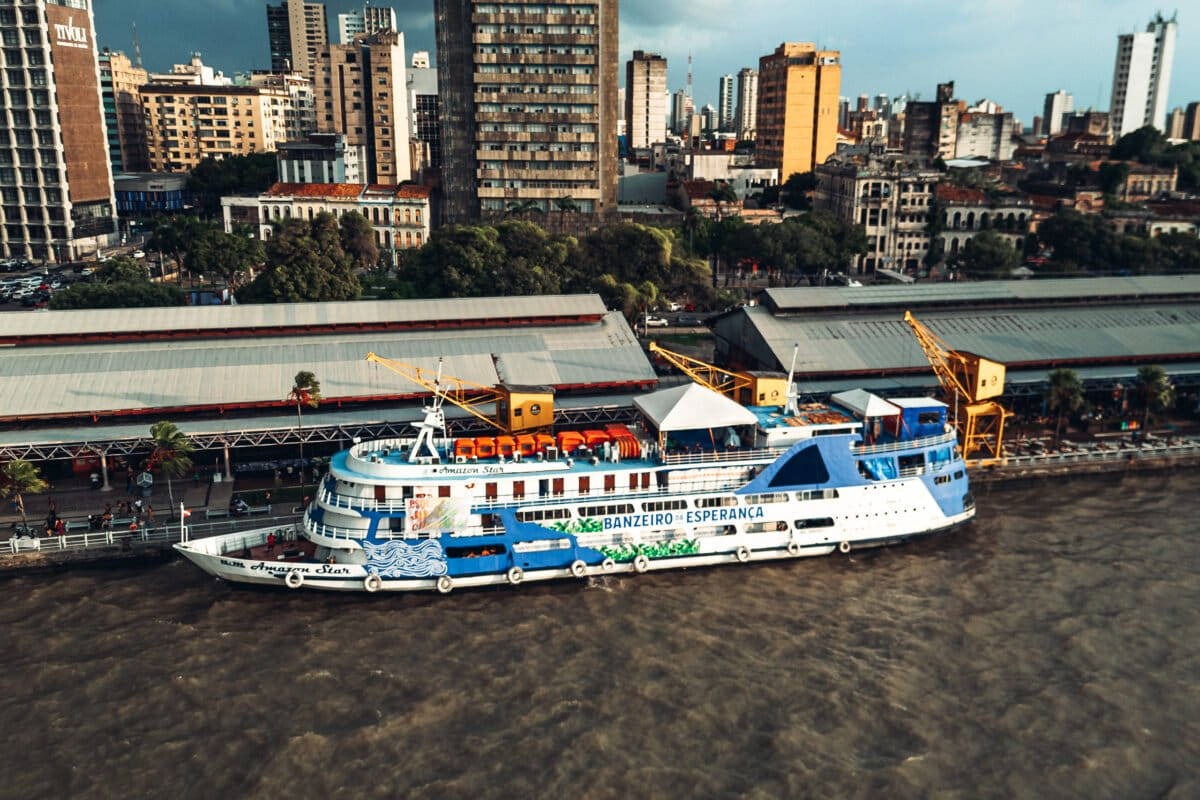
We have ended up organizing over 600 community workshops that led to the drafting of 99 adaptation plans, and in the Boat of Hope, we were able to showcase the top 30 plans and refine those plans with the inputs of scientists, of different stakeholders in a very open dialog. And this has created a portfolio of short-term action for these management plans, which cost about 2 million US dollars.
But it also allowed us to have a big picture. And the big picture is that we need to mobilize 4 billion US dollars to do climate justice in the Amazon, and this is the first time that such a number is produced, and it has been produced through a bottom-up process that takes into account the views and perspectives of Indigenous and local communities.
Mongabay: What are you hoping to see emerge from COP?
Virgilio Viana: I hope to emerge a coalition of those that are willing to mobilize resources for action. I think this is the most important outcome of Belem, which is collective action for now, everywhere and everyone at the same time. We need to act quickly, since we are in an emergency.

So I think the negotiations are always relevant, but I think the most relevant outcome is the mobilization of resources and capacities of different stakeholders to act now.
Mongabay: International climate finance has often struggled to reach those who are actually protecting forests. What changes are needed to fix that?
Virgilio Viana: We need to change radically the mechanisms of financial flows, both so as to allow an increase in the volume, but possibly even more important to reduce the bureaucracy and speed up the process of reaching the ground.
There is a lot of frustration of Indigenous peoples and local communities that the funds that have been talked about since the Paris Agreement do not reach the ground, and this is in part because of the bureaucracy of the financing mechanisms. So we need to change that radically. And in that regard, I think civil society organizations play a very important role to deliver action in a way that is both efficient and effective in the short run, as well as maintaining a long-term perspective.
Mongabay: How do you see the relationship evolving between science, traditional knowledge, and innovation in shaping the Amazon’s future?
Virgilio Viana: There is a great opportunity of building an ideological bridge to the future. This is the combination of ancestral knowledge systems with modern science and technology, and this requires researchers to be humble and test their questions beforehand with the local communities first to see if they are the most relevant. Perhaps they are not the most relevant.

So I think having those Indigenous peoples and local communities shaping the problem, defining the problem, is the first step. The second step is to have them participating actually actively in the design of the methodologies and in the results that are coming out of this, so that it incorporates their wisdom and knowledge systems.
Mongabay: In the face of so many challenges, what gives you hope for the Amazon?
Virgilio Viana: Hope for the future of the Amazon is dependent on action, and there are a lot of positive things happening in the Amazon that usually don’t make up to the news, because communication tends to give more space for disasters and tragedies, and not so much to positive stories.

But here, those of us who live in the Amazon, we know that there are many positive things happening. They just need to be scaled up.
Mongabay: When you think about the Amazon 20 years from now, what future do you believe is still within reach if the right decisions are made today?
Virgilio Viana: I think it is still possible to be hopeful that we are going to have strong action by Indigenous peoples and local populations in protecting their forests, better governance so that illegal activities can be controlled and brought down to a minimum, that we reduce deforestation to zero, that we restore as much as possible.
And this meaning not only restoration in strict sense, but also recuperation of forests through agroforestry systems for productive uses, but using trees, and international cooperation in all regards to support those actions with a sense of having a big picture, thinking bold, but also acting quickly and pragmatically now on opportunities to scale up existing solutions that have been proven successful.