
- Across Southeast Asia, forest carbon projects intended to offset greenhouse gas emissions are falling short on social justice safeguards, according to recent research.
- The study identifies weak governance, land tenure conflicts, corruption and fragmented policies as contributing to the shortcomings.
- Well-managed forest carbon initiatives have an important role to play in global efforts to reduce emissions, the researchers say, but they must center the rights of traditional custodians of forests.
- Against the backdrop of global democratic backsliding, experts urge greater scrutiny of project accountability to uphold social and environmental standards within the carbon sector.
Home to Asian elephants, gibbons and critically endangered black-shanked douc langurs, the forests of Cambodia’s Keo Seima Wildlife Sanctuary were brought under a REDD+ project in 2010. However, several years into the project, Indigenous communities whose land was absorbed into the project reported legal harassment, crop destruction and property confiscation as a result of land conflicts with the scheme’s implementers.
Across Southeast Asia, forest carbon projects like the one in Keo Seima are falling short on social justice safeguards, according to a recent study published in WIREs Climate Change.
While carbon-offsetting programs have been around for more than a decade, they require continuous scrutiny to ensure they aren’t having unintended negative impacts, said Yingshan Lau, an economist at the National University of Singapore and lead author of the study.
“Forest carbon credits transcend scale and geographies,” Lau said. “Decisions by more privileged groups of people in one part of the world could affect more vulnerable groups in other parts of the world.”
Forest carbon initiatives, such as REDD+ (which stands for “reducing emissions from deforestation and forest degradation in developing countries”), are intended as a way of integrating forest conservation into climate change mitigation.
Countries, companies and even individuals can buy “credits” sold through carbon markets that help them offset, or compensate for, their own emissions that can’t be avoided. These carbon credits are generated by carbon-sequestering activities like conservation of forests and ecosystem restoration.

Supporters of forest carbon projects say initiatives like REDD+ can direct much-needed funding to protect and restore healthy forests, which not only absorb significant amount of atmospheric carbon, but also provide habitats for biodiversity and support communities.
However, research has cast doubt over carbon-based projects’ true climate benefits, questioning whether emissions reductions from initiatives are happening at the scale claimed by their developers. Critics also point to negative social outcomes of poorly implemented carbon projects that fail to protect the rights of the Indigenous peoples and local communities directly affected.
Experts also remain wary about the role of carbon offsetting in enabling polluting industries and countries to use their participation in carbon markets in PR campaigns while they continue to emit greenhouse gases.
The team of researchers from Singapore, the Philippines, Australia and Ireland examined 170 social science reports on the outcomes of REDD+ and other carbon-offsetting schemes across Southeast Asia. They identified weak governance, insecure land rights, corruption and funding shortages as contributing to the shortcomings.
“Forest carbon schemes have been unable to compete with large-scale drivers of deforestation, tend to privilege scientific and expert knowledge in relation to carbon accounting and geospatial analyses, are significantly limited by national and local governance issues, and have often not provided the intended benefits for local communities,” the study says.
They found many forest carbon projects, particularly REDD+ schemes, prioritize carbon profits at the expense of biodiversity. Initiatives managed as reforestation projects, for instance, frequently focused on planting monocultures of little value to nature beyond carbon sequestration.
Projects that failed to center the rights of affected communities typically faced stiff local opposition, the researchers note in the study, with protests and rejection of benefits seen in projects in Indonesia and the Philippines. However, projects that clarified land tenure early on in the implementation phase showed improved chances of success and more equitable benefit sharing later on.
“At the project level, the support and involvement of local stakeholders is important, for which project implementers need to spend time and effort building trust,” Lau said. “However, many additional factors also need to fall into place — these include technical capacity-building, high-level political support, and the price of carbon.”
Better accountability and local safeguards
The new research is timely given the rapidly evolving forest carbon market in Southeast Asia and across the world, according to Maria Brockhaus, a professor of international forest policy at the University of Helsinki in Finland, who wasn’t involved in the study.
Brockhaus, who led the policy component of a global comparative study on REDD+ published by the Center for International Forest Research (CIFOR), said she agreed with the authors’ conclusions that more research is required on the accountability of projects backed by carbon credits.
Democratic backsliding in countries like the U.S. and Brazil, and a sweeping deregulation law in Indonesia, have weakened environmental and social protections. In light of this, scrutiny of state and private sector involvement in carbon projects should be addressed as a matter of urgency, Brockhaus said.
“We’ve seen attacks on environmental (and social) standards and safeguards, including the undermining or even blunt destruction of long-term data sets,” Brockhaus said. “What all these efforts and legal changes have in common is that they aim at providing fast access for selected interests and remove concerns over social and environmental outcomes.”

Brockhaus said improving the success of carbon-market projects for people, the climate and nature will require restoring decision-making power to Indigenous peoples and local communities. They should hold the rights to decide whether or not to engage with carbon trading on their lands, and those rights should be protected, she said.
“This however goes completely counter to current trends I see in forest, land and climate governance,” Brockhaus said. Major policy obstacles she pointed to include how carbon projects, including social forestry initiatives, are increasingly managed as for-profit, market-driven enterprises that treat local people as entrepreneurs rather than rights holders.
This approach risks forest carbon projects prioritizing returns over social and ecological benefits, she noted, and undermines the “probability of re-transfer of rights back to local people [and] of a lasting stewardship of forests and forest lands by Indigenous people.” As long as projects remain shaped primarily by markets and geopolitics, she said, people and nature will continue to lose out.
Lau said empowering local communities through education is a vital step. He suggested carbon credit literacy programs could help communities better understand how local resources are being commodified, the risks entailed, and what rights they have to object to schemes through consultation processes, such as free, prior and informed consent (FPIC).
Safeguards that protect communities against land grabbing, forced eviction and state control of resources should be in place as standard, according to the study. The authors also urge greater respect for traditional forest management practices that support biodiversity, and therefore carbon storage.
“Traditional forest management systems, such as the collective management of forests in some communities, are institutions that have established legitimacy and trust and that incorporate the local knowledge of a particular social-ecological context,” Lau said.
Other ways to ensure local people aren’t left out could be extending initiatives beyond REDD+ to encompass ecosystem restoration and agroforestry, the study notes, which could improve the balance between carbon, livelihoods and ecological outcomes.
According to Lau, it’s in developers’ interests to build and maintain strong relationships with local communities. “Identifying what aspects in a community’s culture is closely linked to nature and wildlife [could help] rally more support for biodiversity enhancement,” he said.
Projects that work closely with communities from the outset also shore up the confidence of buyers in the carbon credit market, Lau noted, effectively ensuring a steady flow of funds to forest conservation and nature-based solutions to climate change.
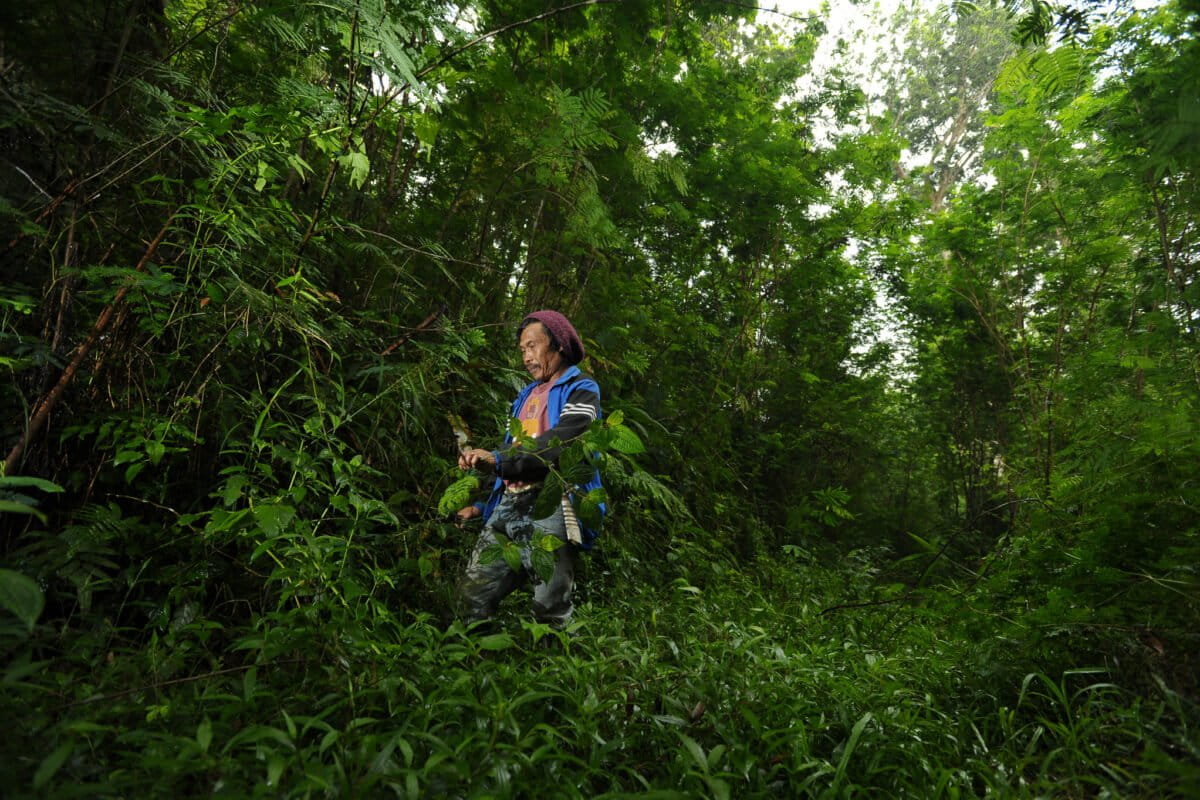
Banner image: A man cutting dead twigs to be used as firewood on Mount Gede, Indonesia. Image by Ricky Martin/CIFOR via Flickr (CC BY-NC-ND 2.0).
Carolyn Cowan is a staff writer for Mongabay.
Citations:
Lau, Y., Kenney‐Lazar, M., Bashir, S. N., Cole, R., Gevaña, D. T., Lee, J., … Zhou, Y. (2025). Challenges in forest carbon governance: Insights from Southeast Asia. WIREs Climate Change, 16(5). doi:10.1002/wcc.70018
Jones, J. P. G., & Lewis, S. L. (2023). Forest carbon offsets are failing. Science, 381(6660), 830–831. doi:10.1126/science.adj6951
See related story:
The future of forest carbon credits and voluntary markets
FEEDBACK: Use this form to send a message to the author of this post. If you want to post a public comment, you can do that at the bottom of the page.