By Brian Mier
In a new peer-reviewed academic article in Latin American Perspectives (11/19/23), “Anticorruption and Imperialist Blind Spots: The Role of the United States in Brazil’s Long Coup,” Sean T. Mitchell, Rafael Ioris, Kathy Swart, Bryan Pitts and I prove beyond a shadow of a doubt that the US Department of Justice was a key actor in what we call Brazil’s “long coup.” This was the period from 2014, beginning with the lead up to the illegitimate 2016 impeachment of Dilma Rousseff, to the November 2019 release of then-former, now-current President Lula da Silva from political imprisonment.
“For over half a century, intervening against democratically elected governments has been only half the story,” we wrote; “the second half involves justifying, minimizing or denying US involvement.” The article criticized US scholars on Latin America for ignoring a significant body of evidence of this involvement. It called on Latin Americanists to return to the anti-imperialist tradition that established their field as a leading source of informed criticism of US foreign policy.
In this article, I will make the same call to US journalists who lived in Brazil during this period who remained silent about their government’s role in removing Brazil’s front-running presidential candidate in the 2018 elections, opening the door for the right-wing extremist No. 2 candidate, Jair Bolsonaro.
“For over half a century, intervening against democratically elected governments has been only half the story,” we wrote; “the second half involves justifying, minimizing or denying US involvement.” The article criticized US scholars on Latin America for ignoring a significant body of evidence of this involvement. It called on Latin Americanists to return to the anti-imperialist tradition that established their field as a leading source of informed criticism of US foreign policy.
In this article, I will make the same call to US journalists who lived in Brazil during this period who remained silent about their government’s role in removing Brazil’s front-running presidential candidate in the 2018 elections, opening the door for the right-wing extremist No. 2 candidate, Jair Bolsonaro.
Collusion revealed
For nearly five years, Brazil’s huge anti-corruption investigation, called Operation Car Wash (Lava Jato in Portuguese), received glowing coverage in US media (FAIR.org, 3/8/21). Articles treated investigation and trial judge Sergio Moro as a heroic, anti-corruption crusader, rarely challenging the public prosecutors’ official narrative. Media failed to question judicial overreach, even when prosecutors did things like illegally wiretap former President Lula da Silva’s defense team’s law offices (Consultor Jurídico, 12/19/19).
This narrative began to crack in 2019, thanks to a long, slowly released series of articles in the Intercept, based on a huge archive of hacked Telegram chats revealed by hacker Walter Neto Delgatti. The texts showed collusion between the Operation Car Wash taskforce and Judge Sergio Moro, and revealed, among other things, that they knew they didn’t have enough evidence to prosecute Lula in a fair trial (Intercept, 6/9/19).
Four months after Lula was released from jail, while the Covid-19 pandemic was dominating world headlines, Intercept Brazil’s 97th article in the series (3/12/20) revealed that a team of 18 FBI agents, led by special agent Leslie Backschies, had met regularly with members of the Car Wash taskforce for years.
During these meetings, FBI agents coached the Brazilian prosecutors on using media leaks to damage the reputation of top-ranking Workers Party officials, including Lula. They also gave lessons on effective use of the coerced plea bargain, an ethically questionable tactic, widespread in the US, that had recently been legalized in Brazil.
The Intercept article was the final evidence that Brazilian journalists who had been challenging the official narrative on Operation Car Wash had been waiting for for years. However, there was already enough public record of the DoJ role in Car Wash before the Intercept article. In June 2019, Brazilian congressmember Paulo Pimenta had presented a dossier to the European Parliament, and a group of Democratic US congressmembers, in which he made a convincing argument that DoJ wasn’t just a partner, it was leading the investigation.
Hardly a secret
The US role in Operation Car Wash was hardly a secret that had to be uncovered by rigorous investigative reporting. Between December 2016 and June 2019, the DoJ publicly acknowledged its relationship with the Car Wash taskforce in a handful of press releases and a speech (7/19/17) made by Acting Assistant Attorney General Kenneth Blanco at the Atlantic Council.
For example, the DoJ put out a press release (12/21/16) about the largest foreign bribery case ever settled in a US court, which levied $3.5 billion in fines on Brazil’s Odebrecht Construction Company and Braskem Petrochemicals. The release bragged about the collaboration of the FBI’s New York field office, the DoJ Criminal Division’s Office of International Affairs and the US SEC with Brazil’s Federal Public Ministry and Federal Police.
A Reuters article (12/21/16) on the same subject described Operation Car Wash as a Brazilian investigation that involved collaboration with US authorities, who said they hoped “to pursue more criminal cases that fall under their jurisdiction.”
The New York Times article (12/21/16) on the ruling described Operation Car Wash and quoted Sung-Hee Suh, deputy assistant attorney general of the DoJ Criminal Division:
Such brazen wrongdoing calls for a strong response from law enforcement, and through a strong effort with our colleagues in Brazil and Switzerland, we have seen just that.
In 2016, US collaboration in Operation Car Wash was also widely covered in Brazil’s corporate media. For example, one of Brazil’s largest daily newspapers, Estado de S. Paulo, ran an article (5/21/16) whose headline translates as “US Justice Department Increases Corruption Investigations Against Car Wash Companies.” The story reported:
DoJ staff have been in permanent contact with the Brazilian judiciary in search of information on corruption, and also to collaborate with Brazilian investigations, say our sources. Recently, the chief of the Department of Justice’s FCPA Unit, Patrick Stokes, came to Curitiba, where he spent four days meeting with Judge Sergio Moro and members of the Car Wash taskforce.
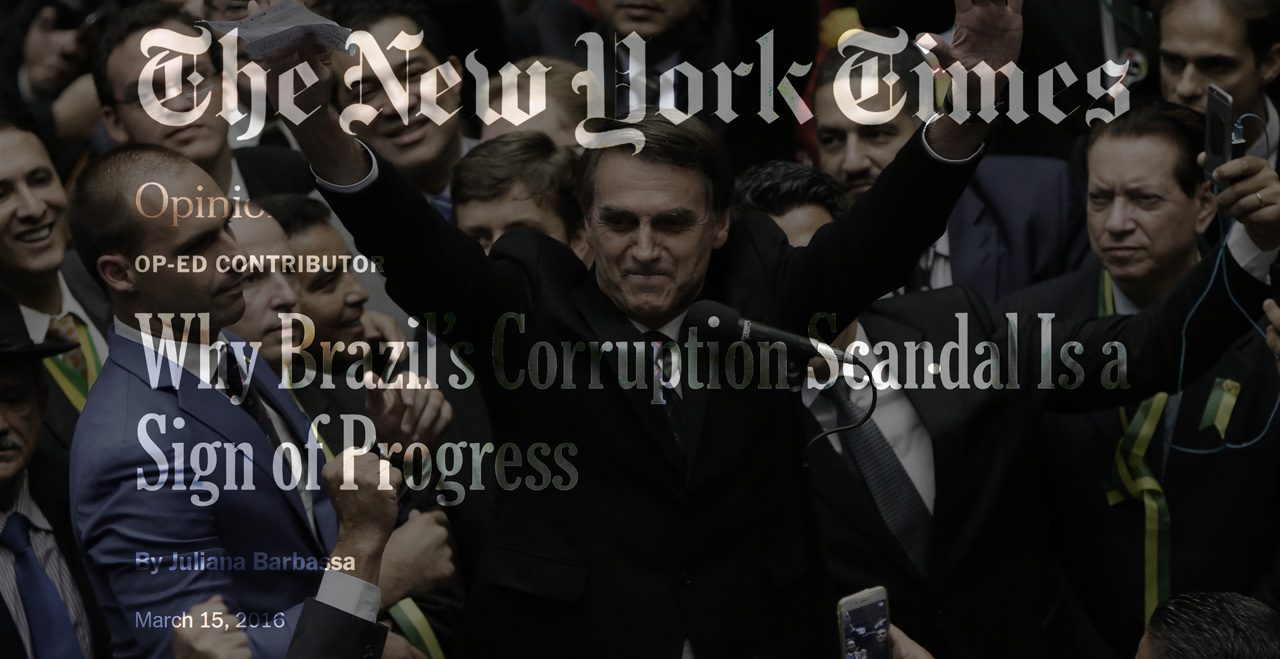
December 21, 2016, was the last time US involvement in Operation Car Wash would be mentioned in the New York Times until February 26, 2021, in an op-ed article (2/26/21) by Gaspard Estrada.
Disappearing connection
Anyone who was following news on Brazil closely should have known by the end of 2016 that the US DoJ was a partner in Operation Car Wash. Furthermore, even if a journalist had missed all the articles in the US and Brazilian media about the DoJ’s role in the investigation in 2016, wouldn’t the long history of US interference in progressive governments in Latin America prompt any reporter interested in finding the truth to investigate the issue?
To the contrary, during that horrible year of 2017, when the coup government set labor rights back 80 years, privatized key sectors of Brazil’s economy, drove millions below the hunger lineand set up Brazil’s most popular political leader in history for arrest without presenting any material evidence, the issue of US involvement in the process all but disappeared in the US media.
In July 2017, Acting Assistant Attorney General Kenneth Blanco gave a speech at the Atlantic Council that was transcribed and published on the DoJ website and made available for viewing on YouTube. In it, he bragged about Lula’s conviction and praised the constant, informal communications between DoJ officials and the Car Wash taskforce.
That September, Pulitzer Prize–winning journalist turned Fox News regular Glenn Greenwald gave a keynote speech at an event hosted by Canadian billionaire Peter Allard, in which he heaped lavish praise on the Car Wash taskforce. Nevertheless, in early 2019, he would accept a portion of the leaked Telegram chats between the taskforce members, leading to the Intercept article series that demonstrated their collusion with Judge Sergio Moro. It was a brave act of journalism that earned Greenwald numerous death threats. But as of April 2022, as documented in a FAIR article (4/3/22), he still hadn’t mentioned US involvement in the investigation.
On the pages of the New Yorker in July 2017 (7/13/17), Alex Cuadros, who had honed a progressive image, labeled the kangaroo court procedure that removed Lula from the 2018 elections, which ushered in the presidency of the neo-fascist Bolsonaro, “the Most Important Criminal Conviction in Brazil’s History.” He made no mention of the DoJ’s role in this “most important” conviction.
Moving forward, a slew of 2019 “what went wrong” articles released after Lula’s arrest, Bolsonaro’s rise to the presidency, and his appointment of Car Wash judge Sergio Moro as Justice Minister, including Vincent Bevins’ Atlantic article “The Dirty Problems With Operation Car Wash” (8/21/19), failed to mention the dirty hand of the US.
Even progressive Jacobin, which ran 38 articles with a negative take on the Brazilian Workers Party between 2014 and the end of 2017 (Brasilwire, 12/12/18), appears to have only run its first article mentioning US involvement in Operation Car Wash in August 2020, five months after the Intercept (3/12/20) finally published leaked Telegram chats documenting collusion with the DoJ and FBI and 9 months after Lula was released from jail.
Too high a career cost?
Why would so many Brazil specialists—even those like Greenwald and Bevins, who have reputations as being fierce critics of US involvement in coups in other countries—remain silent on the DoJ’s role in Brazil’s long coup?
Could they have simply missed the 2016 New York Times and Reuters articles, the DoJ press releases and the Brazilian press coverage of the issue? If so, it shows that they aren’t as knowledgeable about Brazilian politics as they present themselves to the reading public.
But more likely, the omission of the DoJ role suggests that there’s a much higher perceived cost, career-wise, to saying “the US has corrupted this government” than “this government is corrupt.”
If, for whatever motive, journalists knew about Washington’s involvement and chose not to write about it—as a Guardian journalist made clear to me in a personal conversation in April 2018, on the eve of Lula’s arrest—they are complicit in what Gaspard Estrada (New York Times, 2/26/21) calls “the biggest judicial scandal in Brazilian history.”
(Article originally published at FAIR and reproduced with permission.)