

Donald J. Trump exploits the super power of the U.S. (by virtue of holding the presidency) and uses it to skillfully but desperately play with the hopes and fears of people in the socio-political world of our era in 3 major ways (i.e., market-capitalist vice, liberal democratic dysfunction, and American imperialist decline). The important point to remember is that the phenomenon of Trumpism reflects a historical infection point from the last stage of Pax Americana to a rapidly changing post-American new world order, ultimately unto the direction of “post-capitalism” and “post-democracy” in “post-civilization” around the “Asian 21st century” and beyond.
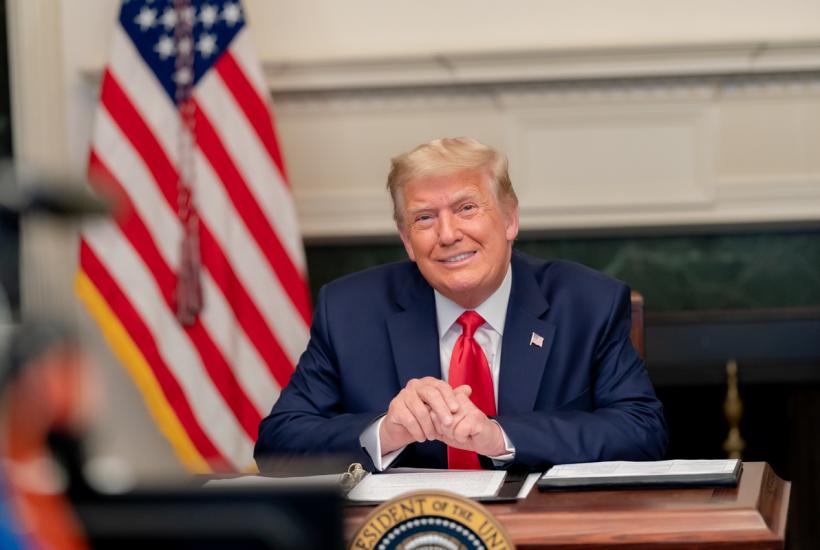
Photo: commons.wikimedia.org by The White House from Washington, DC, https://creativecommons.org/public-domain/pdm/
Donald Trump
1st Way of Manipulation: Trump’s Greed, and the Market-Capitalist Vice
The first way of Trumpism to manipulate hopes and fears in our era is that, contrary to political correctness in Western mainstream mass media, Trump’s greed reflects the market-capitalist vice which elevates “greed” as “good,” as fashionably portrayed in the 1980 film “Wall Street.” The central obsession of Trump’s professional life is with “money, money, and money,” as Trump himself said (in a January 2016 rally): “My whole life I’ve been greedy…I’ve grabbed all the money I could get. I’m so greedy. But now I want to be greedy for the United States.”
In this sense, Trump’s economic modus operandi is based on a ruthless greed-based tool of extortion and bullying. For instance, in trade, he uses “tariffs” against the rest of the world — both friends and foes alike. He blames the massive U.S. trade deficits on the rest of the world, just as a consumer would blame a supermarket for his transaction deficits because he buys from the supermarket but the supermarket does not buy much from him. Trump’s solution is to extort as much money as he could from the rest of the world by imposing tariffs on each of them, hoping that his “beg your neighbors” tariffs would eliminate or reduce U.S. trade deficits. This is the classic trademark of a greedy bully with no moral scruples for fairness or reasonableness, to the point of criminality (with a wicked sense of pride, as he is a “convicted criminal,” after being convicted of 34 felonies in a New York court in 2024).
But the consequences of Trump’s extortion by universal tariffs would bankrupt or hurt the U.S. in the long term, just as Trump had suffered at least 6 major bankruptcies in his business life, besides many financial problems that his bankers had the misfortune to encounter from him over the years. In the 2024 book “Lucky Loser,” Russ Buettner and Susanne Craig documented the failures of Trump’s business endeavors, so much that he had to spend much time to fabricate the illusion of his success story. For someone as privileged as Trump who had inherited (starting when he was a toddler) about half a billion dollars over the years from his father’s real estate empire with suspect tax schemes (as reported by The New York Times in 2018), not to mention different social connections with the “higher class” and “social elite” in American society, his business failure is deeply troubling, since, as reported by Dan Alexander in 2021, he could be so much richer than what he currently has if he had simply done nothing and just left his massive financial inheritance from his father to S&P 500 in the past decades instead.
Similarly, but now on the global stage, Trump’s extortion by universal tariffs can bankrupt or hurt the U.S. in the long term, in 2 major ways.
First, his extortion by universal tariffs practically forces other countries to diversify their trade relations, away from the United States. For instance, Trump’s main target, China, had already started the process of “dual circulation” (which strives for self-reliance by relying on its huge domestic market and yet simultaneously diversifies its trade relations with the outside world by increasing its trade shares with Asia, Africa, and Latin America, while reducing its trade relation with the U.S. since Trump’s first term, as its overall market share in the U.S. had dropped to 13.9% by 2023, from 21.6% some years before, and China’s reduction further continues now in Trump’s 2nd term). Meanwhile, the EU is trying to reduce its trade dependence on the U.S. by doing more trade with Canada, China, Japan, ASEAN, and the like. Thanks to Trump’s crude protectionism, the U.S. will become more isolated from the rest of the world.
Second, the U.S. will suffer from slower economic growth, because of the compounded effects of (a) less trade relations with the rest of the world, (b) increased price levels inside the U.S. (partly due to the increased universal tariffs on imported products and partly due to increased domestic supplies as substitutes which are protected from tariffs but are not competitive in both price and quality), and © the loss of the dollar dominance (or exorbitant privilege) as a result of excessive sanctions by the U.S. alliance on the non-West — as already elaborated in my 2023 article titled “De-Globalization and De-Dollarization in the 2nd Cold War.”
In sum, Trump’s extortion by universal tariffs is based on non-rational greed-based protectionism which violates and thus undermines the very foundation of the rules-based international trade order (like the WTO) which the United States had worked so hard for decades to build for its own prosperity since the end of WWII. The point here is not that the rules-based international order is perfect or does not need to be changed or updated, but that Trump’s extortion by universal tariffs is ineffective and self-defeating in the long term.
2nd Way of Manipulation: Trump’s Deceit, and the Liberal-Democratic Dysfunction
The second way of Trumpism to manipulate hopes and fears in our era is that, contrary to political correctness in Western mainstream mass media, Trump’s deceit reflects the liberal-democratic dysfunction in party-politics, where political leaders often lie to manufacture consent.
There is a saying in American politics, which is that “the business of politics is lying.” Like all generalizations, it is not an absolute truth but indicates a common perception and concern about untruth and untruthfulness in liberal democratic party-politics, where political candidates and politicians routinely manipulate and cajole voters and constituents for their own interests, while colluding with the rich and powerful elites.
Trump is no exception to this dysfunctional (corrupt) aspect of liberal democracy; in fact, presidential historian Michael Beschloss once said: “I have never seen a president in American history who has lied so continuously and so outrageously as Donald Trump, period.” The Washington Post on January 20, 2021 documented “30,573 false or misleading claims” in Trump’s first term, about an average of 21 lies per day.
Trump’s political modus operandi is based on the playbook by his mentor Roy Cohn: “Deflect and distract, never give in, never admit fault, lie and attack, publicize no matter what, win no matter what, all underpinned by a deep, prove-me-wrong belief in the power of chaos and fear,” as discussed by Jim Zirin in his 2024 book “Plaintiff in Chief: A Portrait of Donald Trump in 3,500 Lawsuits” and in the 2019 documentary film “Where Is My Roy Cohn?” by Matt Tyrnauer.
This notorious con man, Roy Cohn, who was disbarred in disgrace in 1986 (before his death), worked in early years as an aide to the infamous senator, Joseph McCarthy (who ruined the lives of countless innocent victims in the name of “anti-Communism”), is known for being “unapologetic,” “remorseless,” and “moral-less,” as Liz Smith put it, or for thriving in a social jungle where “money and power overrules rules and law,” in Eric Hobsbawm’s parlance. Cohn’s “stop at nothing” philosophy fascinates Trump, to the point that he was reported to have said, “Where’s my Roy Cohn?” (in the 2019 documentary film with the same quote above). But the mentee (Trump) outdid his mentor (Cohn) in ruthlessness in the end, as Trump finally abandoned Cohn when the latter, a gay (“in the closet”), was dying of AIDS in 1986 (while being disbarred in disgrace) and thus was no longer useful to him (Trump), or, as Cohn’s secretary, Susan Bell, recalled: Trump “dropped him like a hot potato.” In the last party for Cohn, Trump gave him a gift (a pair of cufflinks) which, as Trump shamelessly lied to him, was made with “real diamonds,” but Cohn felt hurt and betrayed by his mentee (for all that he had done to mentor Trump), when he later learned from Trump’s wife Ivanna that it was made of “cheap pewter and zirconia” instead (not “real diamonds”), as told in the article “The Final Lesson Donald Trump Never Learned from Roy Cohn” in Politico Magazine (on Sept. 19, 2019).
Now on the global stage, Trump follows this ruthless tactic of “lie, deflect, and attack” in dealing with others, both friends and foes alike. For illustration, consider the following 3 examples.
First, in August (2025), Trump slapped a 50 percent tariff on India by falsely claiming that “India is the Tariff King” (as a way to coerce India into making concessions), but India rejected the claim as untrue, since its average tariff stands at 16%, comparable to Turkey (16.2%) and Argentina (13.4%), just as its weighted average tariff is only 4.6%, as reported by NDTV World.
Second, in February (2025), Trump repeatedly made “false claims about the amount of aid the U.S. has given to support Ukraine” by saying that “we are in there for about $350 billion,” but this contradicts government sources which “place the amount…at $174 billion — which includes not only support for Ukraine but also for other countries affected by the conflict, stationing additional NATO troops and more,” as reported by Alexander Hutzler on Feb 26, 2025. Later, Trump used this false claim to ask for a $350 billion (or more) minerals deal with Ukraine, so as to recuperate the fabricated amount.
And third, in February (2005), Trump made the false claim that Panama allowed China to manage the Panama Canal, so he used this false claim to threaten Panama to retake the canal unless Panama offered concessions and allowed the “free transit of U.S. warships through the canal” and stopped doing business with China. But Panama rejected the U.S. claim about Chinese control and also about U.S. ownership of the canal, since it had already managed the canal itself for decades and have continuously “expanded it to completely different channels than the [old] one” originally built by the U.S. in 1904. Shortly after, Panama terminated the Belt and Road Initiative deal with China after Trump’s lie and threat, which led Lina Vega Abad, president of the Fundacion Libertad Ciudadana, to bluntly observe: “We are up against a person [Trump] who tries to gain advantage through pressure, blackmail, lies — a classic bully,” as reported by International Transparency on February 11, 2025.
But Trump’s deceit and bullying can weaken the U.S. in the long term, in 2 major ways.
First, his tactic of deceit and bullying practically forces other countries to lessen their dependence on the United States.
For instance, after Trump’s 50% tariff hike, India immediately paused plans to buy U.S. arms, spoke to Russia’s Putin to reassure their bilateral relationship, and planned to meet China’s Xi later this month to improve the Sino-Indian relationship as a way to reduce its dependence on the U.S. to counter China.
Second, his tactic of deceit and bullying creates an atmosphere of mistrust and uncertainty in the rest of the world vis-à-vis the U.S., which is increasingly becoming an “unreliable” country for others to deal with, since Trump’s chronic lies and abrupt changes in policy with little consistency (partly due to his chronic non-rational mood changes and partly due to his narcissistic transactionism) have much damaged or broken the hard-earned “trust” (over the decades) towards the U.S. around the world. For instance, Canada under the new Canadian Prime Minister Mark Carney now wants “less U.S. dependency,” as the U.S. is now regarded in Canada as an “unreliable” partner, as reported by Reuters on March 11, 2025.
3rd Way of Manipulation: Trump’s MAGA, and the American-Imperialist Decline
The third way of Trumpism to manipulate hopes and fears in our era is that, contrary to political correctness in Western mainstream mass media, Trump’s MAGA reflects the end of American dominance in our era. Pax Americana is living its last sad days under Trump and its aftermath in the foreseeable future.
Trump’s critics strongly dislike Trumpism, so they often under-estimate the popularity of Trump among his MAGA supporters, because the populist policy of “Make America Great Again” resonates well with those in the U.S. who are frightened by the long-term prospect of a rapidly changing world, where America is fast declining across the board (vis-à-vis China as the rising superpower) and is no longer calling the shots. Trump keenly understands (with his political instinct) this frightening “fear” (by many in the electorate) of an America which is no longer great, so he skillfully gives them the consoling “hope” for making America great again. In this way, he deserves the credit to win his 2nd presidency (over his rival, Kamala Harris).
But the policy of MAGA will not bring back a stronger America; instead, it will make it weaker and seal the final fate of the U.S. decline in the emerging Asian century (as already predicted and elaborated in my 2022 article titled “The Closing of the Western Mind in the 2nd Cold War,” which showed the decline of the U.S. across the board under the Trump and Biden administrations, in relation to “decoupling in trade,” “sanctions in finance,” “spy hunt in education,” “hate crimes in civil society,” “extremist populism in political society,” and “containment in global relations”). And the rise of the Asian century was already predicted and discussed in my 1995 doctoral dissertation at the Massachusetts Institute of Technology, or M. I.T. (which was later published in 2 volumes titled “The Future of Human Civilization” in 1999) and in my 2007 book titled “Beyond the World of Titans, and the Remaking of World Order.”
With these prior well-documented (visionary) works in mind, consider the following 5 indicators (for illustration).
First, in the economic sphere, the top 5 economies in the world, if measured by GDP (PPP), according to the IMF estimate (for the 2026 report), are China (43.25 trillion $), United States (31.71 trillion $), India (19.16 trillion $), Russia (7.41 trillion $), and Japan (6.92 trillion $). If measured by global share of manufacturing, the top 5 manufacturing countries in the world in 2023 were China (31.63%), United States (15.9%), Japan (6.5%), Germany (4.7%), and India (2.9%). If measured by largest trading partners in the world, China was already the world’s top trading partner (to more than 120 countries) by 2020, when it surpassed the U.S. as the world’s most dominant trading country (as reported by Iman Ghosh in Visual Capitalist on Jan.22, 2020). And, if measured by total national debts or credits in the world, China is now the “world’s largest official creditor,” as reported by the Lowy Institute (an Australian foreign policy think tank) on May 29, 2025, whereas the U.S. is the world’s largest debtor (with a national debt approaching $37 trillion in 2025).
Second, in the educational sphere, China now occupies 8 of the top 10 best research institutes in the world, as shown in the 2025 Research Leaders world ranking, with the Chinese Academy of Sciences (CAS) being ranked as the top research leader (1st place), followed by Harvard University in the U.S. (2nd place), University of Science and Technology of China (3rd place), Zhejian University (4th place), Peking University (5th place), University of Chinese Academy of Sciences (6th place), Tsinghua University (7th place), Nanjng University (8th place), Max Planck Society in Germany (9th place), and Shanghai Jiao Tong University (10th place).
Third, in the technological sphere, if measured by patent grants (sorted by the World Population Review), the top 5 countries with the most patents in 2025 are China (798,347), United States (323,410), Japan (201,420), South Korea (135,180), and India (30,490). And, if measured by STEM graduates in the world (for scientists and engineers), the top 5 countries (in 2020) were China (3.57 million), India (2.55 million), United States (0.82 million), Russia (0.52 million), and Indonesia (0.3 million).
Fourth, in the military sphere, sometime between 2015 and 2020, China surpassed the U.S. by having the largest army and navy in the world (while catching up both in quality and quantity), and its air force has achieved a great stride in making world-class fighter jets (like the 5th-gen J-20 and J-35, and the 6th-gen J-36 and J-50) and air defense systems (like the HQ-19, notable for its unusual ability to intercept hypersonic and ballistic missiles). Meanwhile, in the armed conflict between Pakistan and India in May (2025), the Pakistani air force used Chinese J10 fighter jets armed with China-made PL-15 missiles to shoot down 3 of Indian new French Rafale jets, even though French Rafale jets are often considered as one of the most advanced fighter jets in our era.
Fifth, in the political-cultural sphere, in an unprecedented historical development since the end of WWII, by May (2025), “global attitude towards the U.S. is souring, with one key adversary [China] now more popular worldwide than the U.S. and another [Russia] hot on its heels, according to new polling. The U.S. is perceived more negatively globally than China and is only a hair more popular than Russia, according to the Democracy Perception Index, a snapshot of global public opinion on democracy and geopolitics developed by the Copenhagen Democracy Summit,” as reported by Will Katcher on May 14, 2025.
Surely, these 5 indicators are not exhaustive, but they suffice to illustrate the decline of the American empire since WWII, especially since Trump in power, starting from 2017 to 2021, and now again from early 2025.
Conclusion: Post-Capitalism & Post-Democracy in Post-Civilization around the Asian Century and Beyond
These 3 major ways for Trumpism to manipulate hopes and fears in the socio-political world of our era have profound consequences to the global landscape, which is rapidly shifting to a new world order to replace the 3-fold populist corruption of Trumpism in the last sad days of Pax Americana, with an emergent new world which is “post-capitalist” (to supersede the “capitalist vice”) and “post-democratic” (to supersede the “liberal democratic dysfunction”) in “post-civilization” (to supersede traditional civilization after Pax Americana in the “American-imperialist decline”) around the “Asian 21st century” and beyond.
This 3-fold historical transformation was already predicted and elaborated in my previous works. For instance, the rise of “post-capitalism” was already predicted and discussed in my 2002 book titled “The Future of Capitalism and Democracy” and in the 2004 book titled “Beyond Capitalism to Post-Capitalism.” The rise of “post-democracy” was already predicted and discussed in my 2002 book titled “The Future of Capitalism and Democracy” and in the 2004 book titled “Beyond Democracy to Post-Democracy.” The rise of China and India in the “Asian century” was already predicted and discussed in my 1999 book titled “The Future of Human Civilization” and in my 2007 book titled “Beyond the World of Titans, and the Remaking of World Order.” The rise of “post-civilization” to replace traditional civilization hitherto existing was already predicted and discussed in my 2005 book titled “Beyond Civilization to Post-Civilization.” And the rise of authoritarianism in liberal democracy (long before national “no kings” protests against “King Trump” in the far-right populism of our time) was already predicted and discussed in my 2007 book titled “The Rise of Authoritarian Liberal Democracy.”
With these well-documented (visionary) books in mind, there is this deep-rooted self-flattering narrative in Western mainstream mass media (also known as the “end of history” thesis), which claims that the capitalist, liberal-democratic system produces political leaders who are inherently “benevolent,” “honest,” “peaceful,” and the like, whereas the non-capitalist, non-liberal-democratic system produces political leaders who are inherently “malevolent,” “dishonest,” “violent,” and the like. But nothing is farther from the truth than this self-flattering narrative. Even the disgraced convicted criminal (for child sex offense) like Jeffrey Epstein, as revealed in the “Jeffrey Epstein tapes,” once said: “I was Donald Trump’s closest friend…He is a horrible human being…He does nasty things to his best friends, best friends’ wives.” Or listen to Trump biographer, Michael Wolff, who had repeatedly warned “how, for even the most loyal subjects, working for Trump ‘ends in tears,'” as reported by Jared Siskin and Patrick McMullan on Wolff’s 2019 book “All or Nothing: How Trump Recaptured America.” With even stronger reason, one must not forget that Trump is a “convicted criminal,” as he was convicted of 34 felonies in a New York court in 2024.
At the national level, the rise of far-right populism in the U.S., with Trumpism as the most recent example (say, for brutal, violent ICE raids by masked men with guns on American streets, who have terrified both citizens and non-citizens alike — comparable to the ruthless raids by the Nazis in Germany and the Fascists in Italy in the inter-war period, both of which are also on the Far Right end of the political spectrum), contradicts this very euphoric propaganda in the “end of history” thesis.
The brutal, violent ICE raids (cheered upon by Trump’s supporters) are by no means a historical aberration in American history, which had already seen other instances like the enslavement of Africans, the encampment of Japanese Americans during WWII, the almost complete extermination of Native Indians, the systemic discrimination against women, the inhumane laissez-faire treatment of the lower class and the homeless, the Chinese Exclusion Acts, the Chinese Massacre of 1871 in Los Angeles, imperial racism (in the Philippine-American War, the Korean War and then the Vietnam War, with the notorious racial slurs like “FKN gooks” and later “FKN chinks”), and now Trump’s “kung flu.” Pax Americana under the capitalist, liberal-democracy fabric cannot last, because it has inflicted so much suffering to so many in the world for so long (in spite of all the benefits on the bright side), and a new civilizational world is emerging to replace it (and is accelerated further by Trumpism, ironically).
In the end, the phenomenon of Trumpism reflects a historical infection point from the last stage of Pax Americana to a rapidly changing new world order, ultimately unto the direction of “post-capitalism” and “post-democracy” in “post-civilization” around the “Asian 21st century” and beyond.
——————–
About the author:
Dr. Peter Baofu is an American visionary and author of 180 scholarly books and numerous articles (as of July, 2023) to provide 150 visions (theories) of the human future in relation to the mind, nature, society, and culture — and had been in 163 countries around the world (as of August, 2025) for his global research on humanity, besides knowing 10 languages with different degrees of fluency. His books are listed in top university libraries and national libraries around the world (including the Library of Congress in Washington, D. C.). He was interviewed on television and radio as well as by newspapers around the world about his original ideas and visions of the human future (search for “Peter Baofu” on YouTube, or go directly to his official YouTube (podcast) channel). He was a U.S. Fulbright Scholar in the Far East and had taught as a professor at different universities in Western Europe, the Caucasus, the Middle East, the Balkans, Central Asia, South Asia, North America, and Southeast Asia. He received more than 5 academic degrees, including a Ph. D. from the world-renowned Massachusetts Institute of Technology (M.I.T.), was a summa cum laude graduate, and was awarded the Delta Sigma Pi Scholarship Key for being at the top of the class in the College of Business Administration, with another student.