
LONDON — It is an ordinary object with an extraordinary history.
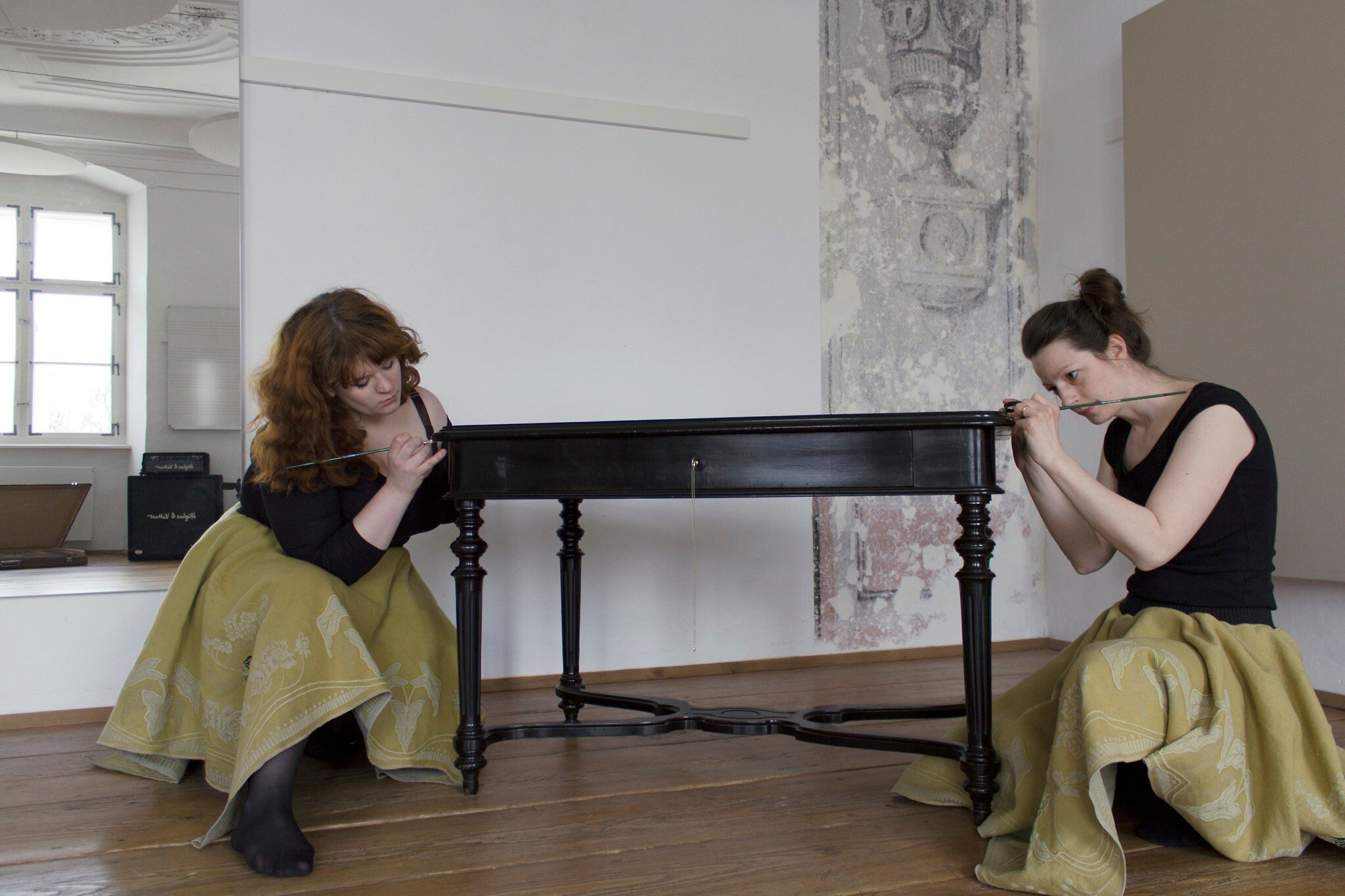
A table stolen from a Jewish family in 1938 — and discovered decades later by the descendant of a local Nazi bigwig in the attic of her family home — is the centerpiece of a new exhibition in London.
“Looted: Two Families, Nazi Theft and the Search for Restitution,” which runs at the Wiener Holocaust Library until October 10, tackles the thorny issue of Austria’s checkered past and its postwar failure to compensate the Third Reich’s victims.
But the exhibit is also a tale of how two women — one the heir of a Holocaust victim, the other of an ardent Nazi — forged an unusual bond to explore their families’ complex pasts and right a historic wrong.
As was the case for so many of their fellow Jews, the Anschluss — when German troops marched into Austria without a shot being fired — ushered in a time of fear, upheaval, and, ultimately, tragedy for the Wertheimer family.
Anna, Emilie and Gabriella Wertheimer’s family roots in the border town of Braunau am Inn stretched back to the 1850s. Although the three sisters had married and moved away by the early 1930s, they had continued to spend summers together at Schloss Ranshofen, an agricultural estate four kilometers (2.5 miles) from the bridge that Hitler crossed from Germany in triumph on March 12, 1938.
Within weeks of the Nazis’ takeover, the sisters’ apartments at Schloss Ranshofen had been looted as part of the campaign of pillage and persecution unleashed against Austria’s Jews. In the summer of 1938, Emilie and her husband, Stefan Jellinek, a pathologist, tried to sell the sisters’ apartments for 300,000 Reichsmarks ($2.7 million in today’s money) — a fraction of a recent court valuation.
The couple was ordered to meet with Braunau’s deputy mayor. Dressed in an SA uniform, he offered them 120,000 Reichmarks — although not before observing that their lawyer had “Jewish manners.” In the end, a local savings bank acquired the property, and the Wertheimers never received a penny.
At the same time, Gabriella and her husband, lawyer Moritz Weisweiller, were being forced by the Gestapo to sell their home in Wimsbach. The couple were given six weeks to leave the Third Reich, with the threat that Moritz would be sent to the Dachau concentration camp if they failed to do so. Together with their son, Rudi, who traveled to the UK as part of the Kindertransport program, the family moved to the city of Oxford in August 1938.
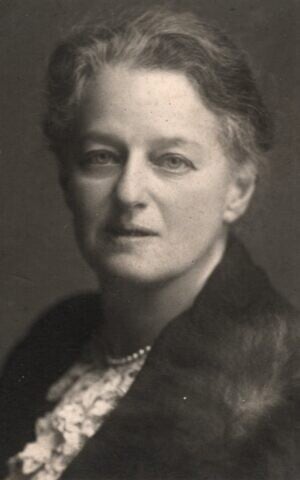
Emilie Jellinek, nee Wertheimer, in an undated photo taken prior to 1946. (Jellinek family collection)
For eldest sister Anna, who lived with her husband, George Schiff, a judge, in Hamburg, worse was to come. After the Kristallnacht pogrom, she was made to hand over several washing baskets full of heirlooms, cutlery and jewelry.
While Jews were having their property looted and expropriated, other Austrians were prospering under the new regime.
Among them was a Josef Kaltenhauser, the son of a tailor from the village of Ranshofen. A teacher, Josef was also a longstanding, secret member of the Nazi party, which, until the Anschluss, had been outlawed by Austria’s right-wing authoritarian dictatorship, the Fatherland Front.
With the Germans’ arrival and the appointment of a prominent Nazi, Arthur Seyss-Inquart, as Austria’s new governor, Josef no longer needed to be shy about his allegiances.
Thanks to his support for the Nazis, he got a new job, replacing the previous headmaster of the Ranshofen primary school, and a new home. On June 1, 1938, Josef and his family moved into the official teachers’ flat in the school building — just across the road from the Wertheimer sisters’ apartments in the estate.
Perhaps predictably, when the sisters’ apartments were looted, some of their property, including furniture, ended up in the Kaltenhausers’ home.
Throughout the war, Josef continued to thrive. His social status was enhanced by his post as headteacher, which he retained until 1945, and his various roles in the local party.
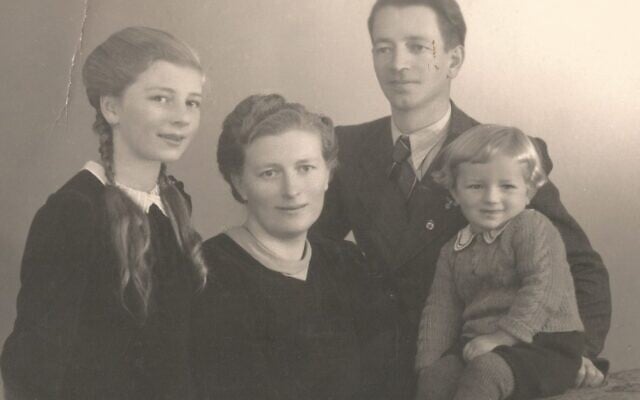
The Kaltenhauser family in December 1941. From left to right: Berta Jr., Berta Sr., Josef Sr., and Josef Jr. (Mayrhofer Family Collection)
Reversal of fortune
The Wertheimer sisters were not so fortunate.
By September 1939, Emilie and Gabriella and their families had reached the safety of the UK, which took in the highest number of Jewish refugees from Austria, some 31,000 people. They had, however, been stripped by the Nazis of their properties and most of their belongings, and forced to pay the extortionate Reich Flight Tax and Jewish Capital Levy. The levy was introduced in 1938 so Jews would “repay” the 1 billion Reichsmark “owed” to the German people for their alleged crimes.
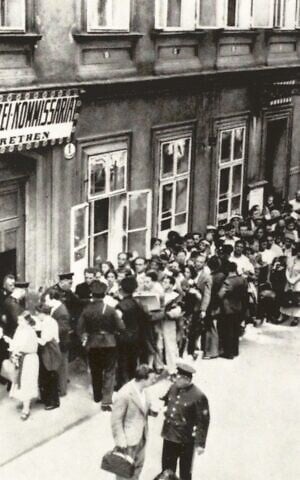
Emigrating Jews queuing outside the police commissioner’s office in Vienna, 1938. (Wiener Holocaust Library collection)
The sisters’ experiences in the UK reflected the complex story of Britain’s wartime relationship with those who had fled to its shores from the Nazis. For a time in 1940, Stefan and his sons, Kurt and Ernst, were interned as “enemy aliens.” Upon their release, the boys served in the British army. Kurt died at 25 of tuberculosis contracted in a military hospital in October 1944, while 23-year-old Ernst was severely injured and lost an eye in a grenade attack weeks before the war’s end.
Anna, however, was never to see her sisters again. Two of her daughters — Anne Marie, who married and traveled to South America in 1936, and Margarete, who arrived in the UK in 1939 to train to be a nurse — were out of harm’s way. But when the war broke out, Anna and her son, Hans, were still trapped in continental Europe.
In 1940, they traveled to Italy, which had not yet joined the war, to catch a boat to Shanghai. But on their arrival, Anna discovered the price of the crossing had increased. She sent Hans ahead to Shanghai, but when Mussolini entered the war on Germany’s side, Anna was forced to return to Hamburg.
By the time the Nazis’ strategy of expropriation and forced emigration had evolved into one of deportation and extermination, some 130,000 of Austria’s 190,000 Jews had fled their homeland.
Anna was one of the approximately 60,000 who, unable to leave, perished. On July 11, 1942, she was forced onto a transport to Auschwitz. It isn’t known whether she died during the hellish three-day journey to Poland or later at the camp.
The fate that befell her family affected Emilie deeply. In late 1945, she suffered a form of mental breakdown, followed by a series of strokes. She died in January 1946.
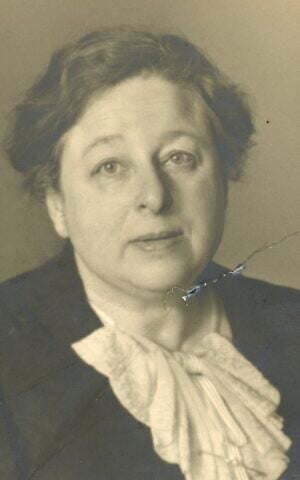
Anna Schiff, nee Wertheimer, in an undated photo. (Schiff family collection)
“As usual with any exhibition that touches on the Holocaust, you can’t escape the losses,” Dr. Barbara Warnock, senior curator and head of education at the Wiener Holocaust Library, told The Times of Israel. “It’s not just property and position, but also the terrible story of Anna and how, ultimately, she didn’t manage to get out — and then the impact that that had on her sister Emilie as well.”
Thanks to Moritz’s legal skills, he and Gabrielle were able to regain their property in Wimsbach — it had been used as a country retreat for senior Nazi officials during the war and taken by the US Army in 1945 — but the family’s efforts to have ownership of their Ranshofen apartments restored proved fruitless.
Local authorities claimed the estate had been purchased in 1939 by the Vereinigte Aluminiumwerke Berlin (VAW), which constructed an aluminum plant to serve the Nazi war effort, “for purely economic reasons” and “not for racial or national reasons.” The savings bank Sparkasse Braunau said the sale had nothing to do with the Nazi regime and that the Wertheimer sisters had not been subjected to coercion. VAW Ranshofen, which was nationalized in 1945, insisted it had only become aware that property on the estate had been owned by Jews after the purchase.
The Wertheimers’ attempts to regain ownership were rejected on the basis that the value of their apartments was outweighed by the investments made in the plant and the economic value it provided to Austria. Instead, they were offered a measly sum in compensation.
In most regards, the Wertheimers’ experience was by no means unique.
“It was a common experience for Jewish refugee families from Austria that came to Britain that they didn’t receive much, if any, restitution,” says Warnock.
As the exhibition notes, restitution in Austria was a “fragmentary and flawed process.” For instance, there was no compensation for missing items — though many victims, of course, were unable to pinpoint the locations of items stolen from them. While Austria passed art restitution legislation in 1998, which required state museums to look for objects stolen by the Nazis that had made it into their collections, the country still has no legal framework covering restitution for privately owned objects.
An unexpected plot twist
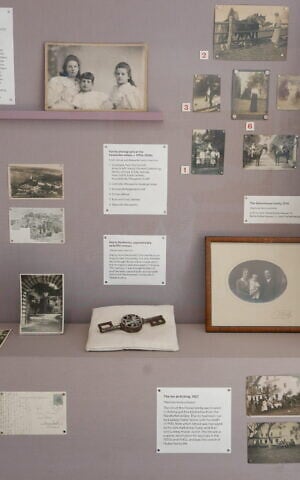
Objects on display at the Wiener Holocaust Library’s new exhibit, ‘Looted: Two Families, Nazi Theft and the Search for Restitution.’ (Wiener Holocaust Library)
But the Wertheimers’ story contains a late, unexpected twist.
In 1945, Josef Kaltenhauser was fired from his post as headteacher of the Ranshofen primary school and was banned from teaching due to his Nazi past. Along with his job, Josef, his wife, and children also lost their home and were forced to move in with Josef’s mother-in-law in Aching, where she had an inn. The family took their furniture — including objects stolen from the Wertheimers’ apartment — with them.
In 1953, Josef, who had been allowed to return to his profession due to a severe shortage of teachers, died of tuberculosis.
Over 50 years later, Katharina Mayrhofer, Josef’s great-granddaughter, found a table in the attic of the family’s inn in Aching. It was in poor condition and had been used as a saw bench, but Mayrhofer, an artist, had studied furniture styles and realized it was distinct from other furniture owned by the family.
Mayrhofer knew nothing of her family’s Nazi past. Her mother knew that the table had some connection to Nazism, with rumors within the family that it had come from Ranshofen. With the help of her mother, Mayrhofer began to investigate why and how the table had come into the family’s possession. In so doing, she became aware of the full scale of her family’s involvement with the party and their actions during the war.
In 2020, Mayrhofer tracked down Emilie and Stefan’s granddaughter, Diana Jellinek, and her daughter, the British artist Helen Emily Davy.
The two young women gradually began to discuss their families’ intertwined histories, sharing documents, images and stories. They also embarked on an artistic project focused on restoring the table.
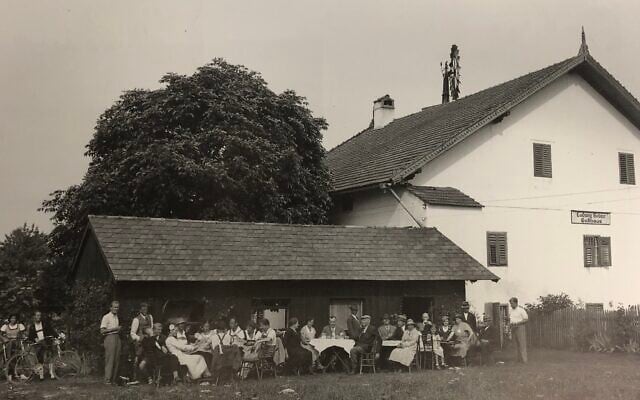
The inn at Aching, 1927. (Mayrhofer family collection)
In 2022, they returned the table to Schloss Ranshofen, viewing this as a form of “artistic restoration.” A year later, it was brought to the UK and entrusted to Diana on behalf of the Wertheimer family.
“In my work at the library over nearly a decade, I have never encountered a similar story at all, and that’s one of the reasons I wanted the library to do the exhibition,” says Warnock. “I was just so struck by this unusual story. We are much more familiar with Jewish refugee family stories to do with persecution and property being lost and failed attempts at restitution.”
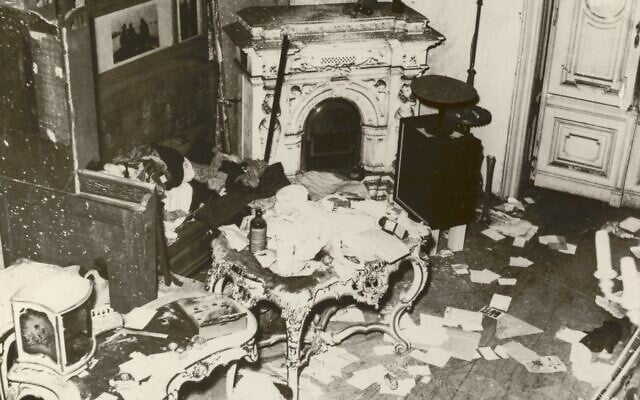
A looted Jewish apartment in Vienna after the Kristallnacht pogrom, November 1938. (Wiener Holocaust Library)
She continues: “What I’ve never come across is this aspect – a descendant of a Nazi family really confronting her family history in this way and going to very considerable lengths to track down the owners and make sure that the property was restituted and then this very touching element of the two women working together to restore the table.”
“We want people to understand these family histories and understand how powerful the story of the two women’s project of reconciliation has really been,” Warnock concludes.