
The World Energy Outlook 2025, released Nov. 12 by the International Energy Agency (IEA), portrays an African continent where energy demand is surging, but access and investment continue to lag.
According to the IEA, Africa’s population is expanding at twice the rate of the global average — and with it, energy demand is expected to increase by more than 50% by 2040 under current policies. Yet 600 million Africans still live without electricity, and millions more face chronic outages.
Africa’s energy growth is accelerating, but access remains highly unequal, the report notes. Average electricity use per person on the continent is roughly one-sixth of the global average, despite rising urban and industrial needs. The IEA warns that this imbalance risks locking communities and businesses into cycles of energy poverty unless policy reforms close the gap between energy generation and affordability.
The IEA credits Africa with expanding solar and wind capacity at its fastest rate ever; the continent’s renewable sector is one of the most dynamic globally. Solar power is expected to supply nearly 40% of new electricity capacity over the next decade, the report finds. North Africa, Kenya and Namibia are cited as emerging clean energy hubs.
Still, fossil fuels remain the backbone of the region’s energy mix. The challenge, the IEA says, is ensuring that renewable energy advances are not undermined by continued fossil expansion.
The IEA devotes a section of the report to Africa’s potential in critical mineral supply chains. Countries including the Democratic Republic of Congo hold significant deposits of cobalt, lithium, nickel and rare earth elements, essential for batteries and clean-energy technologies.
However, most of these resources are still exported in raw form, leaving local economies missing out on potential income from value-added refined products. “If domestic refining is strategically scaled up, the combined market value of key minerals could increase by three-quarters,” the report says.
The IEA underscores that finance remains the single biggest constraint. Clean energy investment in Africa has fallen by nearly a third over the past decade, to about $20 billion per year — less than 2% of the global total.
Climate justice campaigners say the IEA’s findings underline that global inaction is widening inequality. “The IEA’s confirmation that a 1.5°C overshoot is now ‘inevitable’ is a devastating verdict on our collective failure,” said Harjeet Singh, founding director of the India-based Satat Sampada Climate Foundation. “The world is falling short of its climate goals, and the Stated Policies Scenario locks us into a catastrophic 2.5°C world. The primary barrier is financing.”
As the COP30 climate summit unfolds in Belém, Brazil, Singh said, “we must stop delaying and start implementing an emergency response” that ensures climate finance flows to developing regions like Africa — now the fastest-growing region for global energy demand.
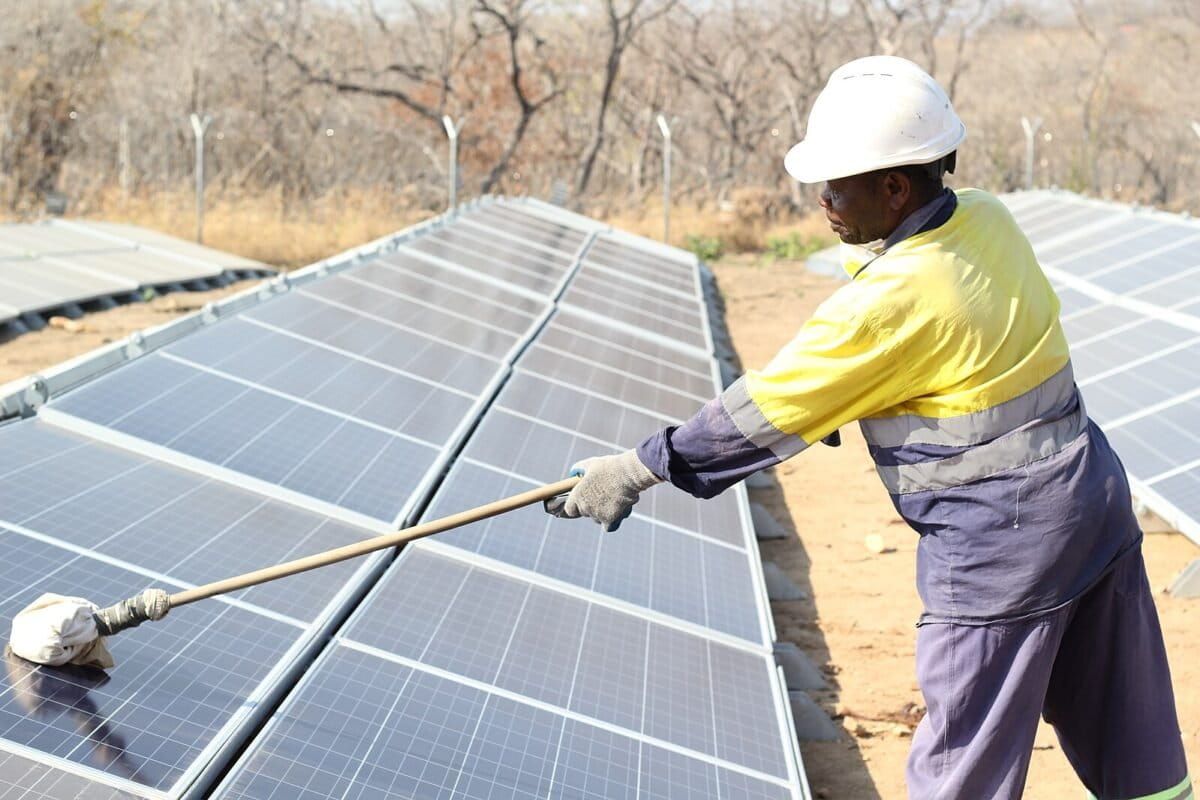
Banner image: Cleaning solar panels, Shanta gold mine, Tanzania. Africa is experiencing an expansion of its solar energy infrastructure. Image by Deo Photographer via Wikimedia Commons (CC BY-SA 4.0).